Three years after the January 2010 earthquake that battered Haiti, the rebuilding effort continues in fits and starts, especially when it comes to health care.
Two years since the beginning of the epidemic, cholera remains a major threat in Haiti, where little has been done to improve the conditions that enable the continued spread of the disease.
Deane Marchbein, president of Doctors Without Borders, spoke about responding to crises in South Sudan, Libya and Haiti on the public radio program "Conversations with Allan Wolper."
Doctors Without Borders/Médecins Sans Frontières (MSF) is providing humanitarian aid to Haitian asylum seekers in Tabatinga, a town in the state of Amazonas, Brazil.
Two years after the earthquake, the health care system in Port-au-Prince and its surrounding areas is still in disarray. Most Haitians still lack proper access to emergency care.
Mary Jo Frawley, a registered nurse from Vermont, went to Haiti days after the earthquake in January 2010. She thought she’d stay a few weeks, but wound up staying for 14 months.
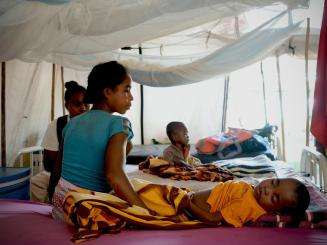
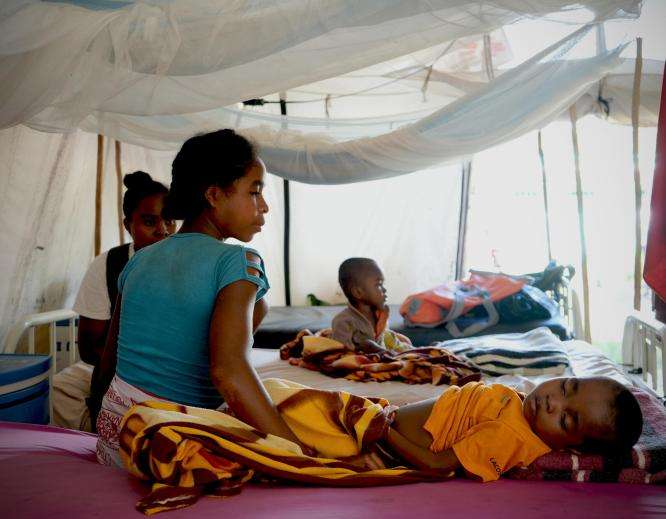
A mother and child rest in the pediatric ward of MSF’s hospital in the Bicentenaire area of Port-au-Prince. Active in Haiti since 1991, MSF has opened five hospitals, including this one, and fought a widespread cholera epidemic in the country since a massive earthquake struck in January 2010.
The consensus is that cholera has taken up a long-term, if not permanent, environmental presence in the country, and as such, the reinforcement and expansion of preventive measures has become vital.
In the immediate aftermath of last January’s earthquake, the potential of an outbreak of disease was a major concern. Months went by without it coming to pass, though, which seemed like a rare victory for the battered population. In September, however, word came from the Artibonite region in central Haiti, , that patients were presenting with cholera-like symptoms. Cholera had not been seen in Haiti in many decades, but the signs—rapid and severe dehydration caused by excessive vomiting and diarrhea—were all too apparent.
MSF staff answer your questions about the organization's massive medical response in Haiti since the January 12, 2010 earthquake in a live webcast panel event.
Following the release of Doctors Without Borders/Médecins Sans Frontières (MSF)’s report, Haiti One Year After: A Review of Médecins Sans Frontières Humanitarian Aid Operations, Dr. Unni Karunakara, MSF International President; Stefano Zannini, MSF Head of Mission in Haiti; and Kate Alberti, MSF Epidemiologist discuss the issues facing Haiti and MSF one year after the earthquake. Avril Benoit, Director of Communications for MSF Canada, moderates.
One year after a devastating earthquake, Haitians continue to endure appalling living conditions amid a nationwide cholera outbreak, despite the largest humanitarian aid deployment in the world.
MSF had already been present and active in Haiti for the past 19 years. It was therefore ready to respond when the disaster struck. And it is now prepared to do the work that will remain in the days, months, and years to come.
From January 12 to October 31, MSF treated more than 358,000 people, performed more than 16,570 surgeries, and delivered more than 15,100 babies. By December 12, MSF had treated 62,000 cholera cases in 47 treatment centers around the country.
MSF has treated more than 12,000 people for cholera and cholera-like symptoms, and the organization is anticipating that the spread of the bacteria will not soon abate.
The Head of Mission for MSF in Haiti gives a first-person account of the situation on the ground for MSF teams responding to the spread of the outbreak in Port-au-Prince.
Among the large scope of MSF activities in Haiti, as of May 31, more than $14.6 million has been spent on surgical care for Haitians injured in the earthquake. At least $5.3 million was spent on maternal health services.
In the last of his week-long series of reports from Haiti, Ray Suarez examines the mental health problems survivors are having following January's devastating earthquake.
In response to the earthquake that struck Haiti on the evening of January 12, MSF launched one of the largest emergency efforts in the organization's history.
Six months after Haiti’s January 12 earthquake, the international medical humanitarian organization Doctors Without Borders/Médecins Sans Frontières (MSF) today released a report describing the organization’s largest ever emergency response.
"Most of the patients present with physical complaints and symptoms such as loss of appetite, memory problems, sleep problems, cardiac palpitations, flashbacks of the event," says MSF psychologist Djénane Marlhen Jean Charles.
Port-au-Prince / New York, 30 March 2010 – With the majority of the Haitian population still extremely vulnerable, donors attending the United Nations conference in New York on March 31, must not take measures that would limit the populations’ access to health care, said MSF on Tuesday.
The conditions in which thousands of people are surviving today are shameful. In assembly areas, there is such overcrowding that people are literally living on top of each other. We have seen people sleeping on the ground, with only a bed sheet hanging over their head for shelter.
“The immediate emergency phase may be over, but the long-term work is just beginning, and it’s no less an emergency,” said MSF Haiti head of mission Karline Kleijer.
What follows is an overview of MSF’s current activities on the ground. MSF had projects running at three sites before the earthquake staffed by approximately 700 people. There are now 20 sites, plus 7 more mobile clinics, staffed by more than 3,000 people. The numbers below are current through the end of last week.
Two MSF surgeons talk about the hard choices they had to make in the aftermath of the earthquake in Haiti, which one said was like working in a war-zone, but "on a larger scale."
Dr. Marie-Pierre Allié, president of Médecins Sans Frontières-France, who recently returned from a field visit to Haiti, analyses the situation there one month after the disaster.
With conditions finally improving for the practice of surgery and medicine, three MSF staff members describe how the teams treated patients in the ruins of the Delmas district in the immediate aftermath of the January 12 earthquake in Haiti.
Dr. Philippe Touchard, an anesthetist, is head of emergencies at the Pasteur Hospital in Langon, near Bordeaux. Forty-eight hours after the January 12 earthquake, he flew to Haiti to reinforce MSF’s surgical teams in Port-au-Prince. Here are exerpts of his journal of this short mission.
MSF continues to focus primarily on providing medical services in hospitals and clinics in Haiti, but teams are also adapting to the evolving situation on the ground.
Nearly two weeks after the January 12 earthquake, the most pressing needs MSF teams in Haiti face are patients who still require surgery and the growing number of patients who now require post-operative care.
We were very lucky because we found a dialysis center at General Hospital. It was broken down—there was no water, there was no electricity because of the earthquake. But with the MSF logisticians we could restart it in 36 hours.
While continuing to perform operations at its fixed sites, MSF has started sending mobile teams into communities in and around the capital to search for people with conditions that could deteriorate rapidly if they go untreated.
MSF emergency physician Sebastian Spencer was working at Choscal hospital in Cite Soleil, Port-au-Prince, on January 20 when the area sustained a strong aftershock. Here he describes what happened.
It hurts to see so many injured children and adults, some of them screaming in pain when the nurse changes the dressing on their wounds. They have suffered serious burns, broken arms, and deep cuts in the skull. They have infected wounded, gangrenous limbs—and the list goes on.
MSF teams focussed on treating injured patients face new challenges, too, with the start of mobile clinics in the capital, of water provision, and of efforts to plan for post-operative care.
By Dr. Rony Brauman, is the former President of MSF in France and is currently a Research Director at CRASH, MSF's center for reflection on humnaitarian action.
On Wednesday morning, as Doctors Without Borders/Médecins Sans Frontières (MSF) teams in Haiti continued to work through long queues of patients waiting for treatment and surgery, the country was shaken anew by a powerful aftershock.
Yesterday I visited the MSF operation at Trinite Hospital. There was a small baby, about six weeks old, lying on her side in her bed because her right arm had been amputated and was covered in bandages. The auxiliary nurse told me her story. Sad and miraculous. She had been in the hospital when the earthquake hit. The building was partially destroyed. This tiny little girl fell through concrete floors and walls. Somehow, she survived and was rescued from the rubble. No one knows where her mother is, though. Chances are she doesn't have a family anymore.
Doctors Without Borders/Médecins Sans Frontières staff in wards and operating theatres in Haiti are still working through very heavy caseloads while growing increasingly concerned about supply problems that threaten the welfare of patients. Drugs for surgical care, basic supplies for pre- and post-operative treatment, and equipment such as dialysis machines are urgently needed, but access problems for cargo shipments are causing delays in delivery.
An MSF cargo plane carrying 12 tons of lifesaving medical supplies has been turned away three times from Port-au-Prince airport since Sunday night, despite assurances of its ability to land.
Benoit Leduc, Doctors Without Borders/Médecins Sans Frontières (MSF) operations manager for Haiti, and Loris de Filippi, MSF operational coordinator in Port-au-Prince, participated in a teleconference with press regarding MSF's response to the January 12, 2010, earthquake.
MSF teams in Port-au-Prince are still under great pressure. While providing emergency care to as many people as possible, they are also searching for additional facilities that can serve as operating theaters and trying to get in more supplies. At the same time, MSF has been travelling to areas outside of the city and is about to extend the medical care to the people there.
Port-au-Prince/Paris /New York, 17 January 2009—Doctors Without Borders/Médecins Sans Frontières (MSF) urges that its cargo planes carrying essential medical and surgical material be allowed to land in Port-au-Prince in order to treat thousands of wounded waiting for vital surgical operations. Priority must be given immediately to planes carrying lifesaving equipment and medical personnel.
On the fifth day of their response to the disaster in Haiti, the MSF teams on the ground remain focused on trying to cope with the huge demand for lifesaving surgery.
"The situation remains critical. Few aid agencies are in place. Hundreds of bodies are still stuck in buildings. In the entire city, I've only seen about four or five trucks and cranes removing pieces of collapsed buildings so they can get the people out."
Surgical units set up by MSF in Port-au-Prince are working around the clock to treat the vast numbers of patients with injuries from Tuesday’s earthquake. Experienced MSF medical staff say they have never seen so many serious injuries.
Surgery needs are huge; more than 300 patients in need of surgery have been tranferred from MSF's Martissant health center to Choscal hospital, a facility in the Cité Soleil district.
Stefano Zannini, head of mission for Doctors without Borders/Médecins Sans Frontières (MSF) in Haiti, spoke at a January 15 press teleconference about MSF's activities in Haiti following the earthquake.
Right now we still are struggling to treat patents in very rough conditions. The biggest problem is not having medical structures where we can treat them. But we have been able to find an open space big enough for the inflatable hospital that should arrive tomorrow. So we will have a 100-bed hospital with surgical capacity operation before the end of next week.
MSF has treated more than 1,000 patients in four tented facilities. The primary concern at the moment is the overwhelming numbers of people who need immediate treatment and major surgery.
Dr. Greg Elder is the deputy operations manager for MSF in Haiti. Here he provides an update on the situation on the ground in Port-au-Prince, Haiti, 24 hours after a 7.0-magnitude earthquake struck the country leaving tens of thousands wounded and unknown number of dead.
"We have three general areas where we have been traditionally providing emergency care with infrastructure established to set up and provide for emergency services. All of those three centers have been severely affected in the earthquake and none of them are in a condition that we can use. One has completely collapsed and two others are so structurally damaged we cannot use them."
The first reports are now emerging from MSF teams who were already working on medical projects Haiti and have treated hundreds of people injured in the quake. "The situation is chaotic," said one senior staff. "I visited five medical centers, including a major hospital, and most of them were not functioning."
Though its own facilities were severely damaged by the massive earthquake that struck Haiti on January 12, MSF field staff have been establishing temporary clinics in order to treat injured men, women, and children. MSF was able to respond immediately because international and national staff had already been running several projects in country.
On January 12, a magnitude 7.0 quake struck about 10 miles (15 kilometers) southwest of the Haitian capital, Port-au-Prince. MSF teams on the ground have witnessed significant damage to its medical facilities, injuries to patients and staff, and an influx of wounded towards these hospitals in the capital.
Doctors Without Borders is approved by the Internal Revenue Service as a 501 (C) (3) tax-exempt organization, and all donations are tax deductible to the extent provided by law. Doctors Without Borders Federal Identification Number (EIN) is 13-3433452.