![]() |
|
||||||||||||||
![]() |
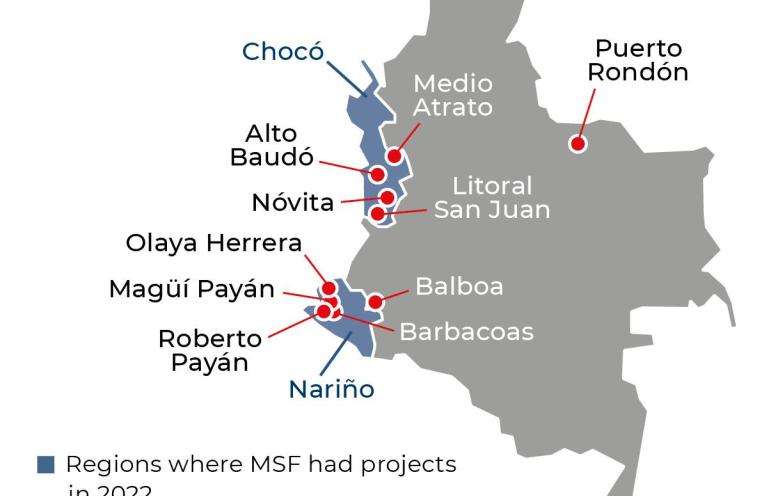
ColombiaActive conflict has afflicted parts of Colombia for over 40 years, with guerrilla groups fighting against government forces, police and government backed paramilitary. In 2007, it was estimated that 3.8 million people had been internally displaced as a result of violent events including massacres, assassinations and intimidation. The psychosocial consequences of living in this climate of fear can be debilitating and has a lasting impact on the lives of many Colombians. Psychological distress is widespread and mental health support is a key component of most MSF projects throughout the country. In 2007, MSF began a new project in Tame, Arauca department. Lags in administration to receive government social benefits leave internally displaced people (IDPs) with gaps in healthcare coverage, and MSF provides medical care to all recent IDPs. Mental health consultations are complemented with training and support for local institutions providing mental health services. MSF is trying to create a support network for IDPs, involving all institutions that provide medical, psychological, economic and family tracing services. MSF also provides medical and psychological care in rural areas of Arauca. In the rural departments of Tolima and Huila, MSF provided 11,074 medical and 4,700 individual and group consultations in 2006. Psychological assistance is available in Algeciras, Casa Blanca, also affected by conflict. In Ibagué, the capital of Tolima, MSF offers primary healthcare to people waiting for their certificate of displacement, which normally grants them access to government healthcare. Near Bogotá, MSF assists the newly displaced in Soacha district, conducting medical consultations and providing mental health support for displaced persons and people excluded from the public health system. The team informs displaced families about their right to healthcare and provides information on gaining access to the complicated government-run health system. Psychosocial care is also provided for people living in Florencia, Caquetá. Approximately 700 patients are seen monthly, most for depression and post-traumatic stress. In addition to providing healthcare via mobile teams, MSF supports health facilities in the Barbacoas region of Nariño province, by training health staff, providing support to rehabilitate rural health structures and implementing water-sanitation and waste management systems. In Uraba, Antioquia, basic healthcare services are provided in a fixed clinic including treatment for commonly found illnesses such as tuberculosis (TB), malaria and leishmaniasis. Mobile teams provide basic healthcare services including vaccination and dental care; water, sanitation and waste management; mosquito net distribution and mental healthcare. There is also a comprehensive reproductive clinic including services for HIV/AIDS and for victims of sexual violence. A similar project operates in the northeastern province of Norte de Santander through a clinic in Tibu. Many displaced people are found in Sincelejo, an urban slum in the northwestern province of Sucré. Here MSF provides basic healthcare services and mental healthcare. Treatment is provided for people with HIV/AIDS, TB, sexually transmitted infections and those who have experienced sexual violence. Water and waste management projects improve the sanitation of IDP barrios. Sexual and reproductive healthcare are provided in Riosucio and Quibdo town, Choco department including medical and psychological care for survivors of sexual violence. MSF also trains staff and local institutions on the use of a post-exposure prophylaxis kit, which can be used to reduce risk of infection after an incidental HIV exposure. In the rural areas of Istmina and Río San Juan, also in Choco, mobile health brigades provide primary healthcare and sexual and reproductive healthcare. Communities in Río San Juan are provided with basic medical services and MSF provides technical support to health posts along the river. MSF runs a health center in Andagoya/Istmina focusing on the health needs of women and provides housing in Andagoya for women in later stages of pregnancy who normally live in remote riverside areas. MSF has worked in Colombia since 1985. |
||