Home Site Map Contact Us Donate E-mail Newsletter xml  
 
  • Print
  • E-mail
  • Share

Field News

Sudan

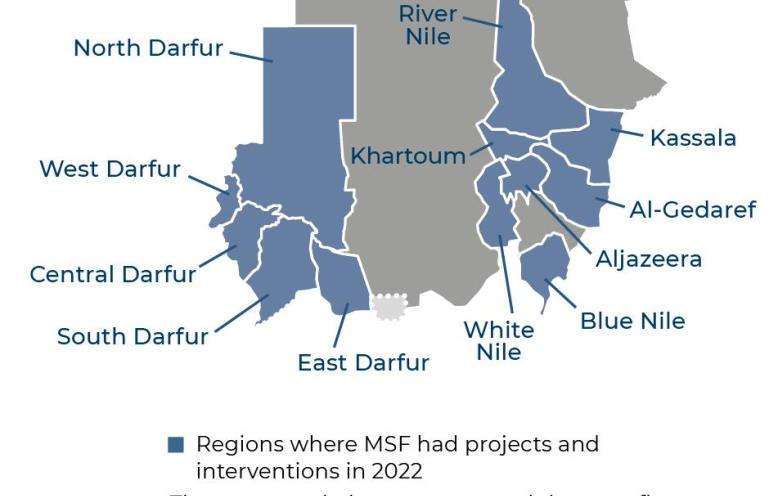
MSF projects in Darfur

West Darfur

At the end of 2007, MSF handed over its project in a Habilah, near the border with Chad, to another non-governmental organization. MSF’s activities, which started in 2004, consisted of providing medical care to about 22,000 people, including the resident population and the displaced. The main focuses of the project were women’s health care and mental health care for victims of violence.

In September 2007, MSF had to suspend mobile clinics around El Geneina because of worsening security. Activities in Seleia, in the north of the West Darfur province, were suspended in February 2008 due to a military offensive by the Sudanese armed forces. MSF staff had been supporting a health center in the town providing life-saving surgical care, reproductive health care, in- and outpatient care, management of severe malnutrition, and medical treatment for victims of violence.

At the beginning of the year, international staff had to be evacuated from Seleia for security reasons. Since then, MSF has repeatedly requested the necessary authorizations to allow these staff to return and support their Sudanese colleagues who stayed in Seleia in order to provide medical care to the remaining vulnerable population. These authorizations have been refused. The recent bombings and attacks have now forced all MSF staff to evacuate the area. On March 3, a small team was able to get to Seleia for a short period, but at present there is no possibility of resuming medical activities in the area.

2007 © Sven Torfinn

MSF provides services (outpatient visits and hospital admissions) in Niertiti, at the foot of the Jebel Mara, where the population totals approximately 33,000 people, among whom there are about 20,000 displaced people. The clinic also sees patients from a number of villages around Niertiti, both in government- and rebel-controlled areas. Medical activities are increasing every year. In 2007, MSF teams performed an average of 5,500 consultations and 278 hospital admissions per month. About 20 complicated cases are referred to the hospital in Zalingei every month.

As the insecurity makes it difficult for people to move around, MSF staff travel to Thur, near Niertiti, twice a week. In Thur, the team sees about 200 patients a day, but often has to suspend activities. During 2007, MSF teams were only able to visit Thur for five months out of the year due to ongoing insecurity in the area.

In Kutrum, a rebel-held area, MSF staff perform around 1,900 consultations every month and refer emergency cases to Zalingei hospital. A polio and measles vaccination campaign in September and October reached a total of 9,620 children between six months and 15 years old, and covered most of the West Jebel Mara. It is difficult for MSF’s staff to move around in this isolated area, as it is very insecure and authorizations are required before any movement can take place. As a result, MSF is not able to meet all the needs identified and is sometimes forced to evacuate temporarily.

In Zalingei, where 100,000 displaced people are living, MSF is now working in three of the hospital departments: emergency care, performing 1,130 consultations per month; pediatrics, with 235 admissions per month; and surgical care, with 200 interventions per month. In 2007, there was a sharp increase in the number of severe malnutrition cases admitted to the hospital’s nutrition center—700 children, compared to 419 in 2006. In response, MSF opened two ambulatory nutritional centers, one in Hamedia camp in September, and one in Hassa Issa camp in December. These two clinics treated 1,400 malnourished children in 2007. At the beginning of 2008, the nutritional center in Hassa Issa was closed and MSF opened a new mother-and-child clinic in this camp. As the displaced population grows, so do the medical needs, and the current health facilities in the camps in Zalingei are not meeting these needs.

North Darfur

2007 © Sven Torfinn

In the town of Kebkabiya, just over 150 kilometers to the west of the provincial capital, El Fasher, MSF runs three dispensaries and supports the Ministry of Health hospital. MSF’s work assists about 75,000 people, many of whom were displaced at the beginning of the conflict in 2003 and sought refuge in the city. Malnutrition is on the rise in the area, as people can still not cultivate or grow crops because of insecurity and continue to rely heavily on relief aid for their survival.

In June 2007, MSF was able to restart its project in Kaguro, located in the rebel-held Jebel Si. The project had been put on stand-by since August 2006, after a security incident. Working in one dispensary and supporting five health posts in the area, five international staff and about 60 Sudanese staff provide medical care to over 50,000 people who have been cut off from assistance since 2003, when the area was attacked and most villages burned. The dispensary sees about 3,000 patients a month. Referring patients in need of surgery, such as the war-wounded and women in need of caesarean sections, is very difficult, as many people fear for their lives when crossing the frontline to reach bigger health facilities. In January 2008, approximately 4,200 consultations were performed in the five health posts around Kaguro.

Serious security incidents forced MSF to evacuate its international team from Serif Umra in July 2006. Sudanese staff ran the dispensary—the sole medical facility for a population of 55,000, many of whom have been displaced—for over a year. An international team was able to return to Serif Umra in July 2007. In January 2008, 6,500 outpatient consultations were performed in the dispensary. Patients in need of secondary health care are transferred to hospitals in Zalingei or El Geneina, if security allows.

2007 © Sven Torfinn

In Shangil Tobaya, MSF provides care for the 28,000 displaced people living in the Shangil and Shadat camps. MSF provides in- and outpatient care, a therapeutic feeding program, reproductive health services, and treatment for victims of sexual violence, as well as mental health activities.

In August 2007, MSF started working in Tawila, where close to 35,000 displaced people have gathered in three camps. These people had had no access to any health services since April 2007, when the last relief organization working in the area had to leave because of security problems. MSF started running mobile clinics in the three camps, including a nutritional program and mother-and-child health care, and has set up a small inpatient department in Tawila town. However, the security situation in the area remains very unstable. The MSF team had to be provisionally evacuated in mid-September. In November 2007, the team was able to return to Tawila and continue its activities.

In the coming months, MSF plans to increase the number of mobile clinics in Shangil Tobaya and Tawila in order to provide health care to more people.

South Darfur

2007 © Sven Torfinn

With a population of over 90,000 people, Kalma is one of the largest camps for displaced people in Darfur. MSF works in the camp and runs an outpatient department with consultations for 2,800 patients every month. MSF is also focusing on mother-and-child health care and running a women's health center with up to 200 consultations per day. The center provides ante- and post-natal care, as well as delivery assistance for high-risk pregnancies and referrals for obstetric emergencies. Family planning is available and the MSF team is responding to the emergency needs of new arrivals when and if needed.

MSF is one of three agencies providing full treatment for survivors of sexual gender-based violence. A mental health program addresses the profound psychosocial stress and trauma experienced by the population as a result of the current, precarious living conditions, as well as the psychological trauma related to past conflict. Psychosocial care is given through several hundred private counseling sessions per month, workshops, and support groups. The project is complemented by community outreach activities. In October 2007, when heavy fighting in Kalma camp forced 25 percent of the camp population to flee, MSF medical teams followed them to the areas where they had taken refuge—Majok and Sakeli—to provide them with medical care and essential survival items, such as jerry cans for water, sleeping mats, blankets, and soap.

2007 © Sven Torfinn

Located in a rebel-held area, Muhajariya is a large town in South Darfur, where MSF provides medical care to around 70,000 people. MSF offers surgical care and runs inpatient and outpatient departments and a laboratory, as well as providing reproductive health services with antenatal, postnatal, and family planning assistance. Treatment for survivors of sexual violence is available. Because the nutritional situation is still fragile, therapeutic and supplementary feeding remain integrated into the basic health care programs. MSF teams also provide water to displaced people in settlements around Muhajariya, where community outreach programs are carried out. When the town of Muhajariya was attacked in October 2007, MSF staff continued to treat around 100 patients a day at the height of the conflict. MSF teams then extended the care they provided by organizing mobile clinics to assist the thousands of displaced people who had moved to the north of the town.

The MSF team in Feina (East Jebel Mara) runs an antenatal care and home-based feeding program and sees around 130 outpatients per day. The feeding program has an average of 60 new admissions each month. MSF runs mobile clinics in the area, which includes Deribat, Suni, Jawa, Barkaro, Saboon el Fagor, Dulda, Logi, and Leiba, to bring services closer to these populations who remain scattered in an area of 10,000 square kilometers, and to obtain a more comprehensive overview of their health needs.

Since June 2007, newly displaced families have been arriving in the Bulbul area from other locations in West and South Darfur in search of security. There are now around 25,000 people living in Bulbul, however no relief has been provided for several months. When MSF managed to get to the area, water was a major concern, as there were three hand pumps for all 25,000 people. An MSF team is installing four water stations, which will be able to provide around 500 cubic meters of clean water per day. MSF also has distributed some essential survival items, such as soap and blankets.

View Darfur MSF operational updates from October 2007 and June 2007.

Southern Sudan

Caught between northern and southern Sudan: violence and fighting in Abyei

Following the fighting in Abyei in mid-May, almost 60,000 people have fled the area, which previously had 130,000 inhabitants. Many fled to Turalei and Agok.

An MSF team of 11 people, including a surgeon and an anaesthetist, have been sent to Turalei and Agok to support the displaced people, bringing surgical tools and first-aid materials to meet the needs of 1,705 families, and water purification materials for some 10,000 people. In these two towns, MSF has taken 140 wounded people into its care. In the Turalei Hospital, which has only 40 beds, MSF teams have assembled emergency medical structures under tents to provide primary health care services to the displaced population.

Malnutrition is the most acute problem for the displaced population from Abyei and surroundings. Before the fighting began, malnutrition rates were above 50 percent, based on screenings carried out in the hospital in Abyei, with more than 700 children under five years of age admitted to the nutrition program. MSF teams in Turalei and Agok provide nutritional treatment to children suffering from severe acute malnutrition in ambulatory programs, and operate an inpatient nutritional center for complicated cases. In one day at the end of June, 40 children were admitted to the nutritional program in Agok after assessments were carried out by an MSF mobile clinic in the nearby area of Malual Aleu. With 2,000 children screened there and in the MSF clinic in Agok, the global acute malnutrition rate was recorded at 25 percent. MSF teams are currently treating more than 400 children suffering from malnutrition.

An assessment is being conducted in the most isolated areas to access the populations likely to be most affected. The spread-out populations and the logistical constraints due to the rainy season make it difficult to access all the populations in need. Another MSF team is assessing the areas north of Abyei, and has already provided essential non-food items to 670 displaced families in Muglad, and has provided basic kits to support existing health structures.

Working amid ongoing insecurity

Southern Sudan 2007 © Sven Torfinn

Earlier in the year, clashes between armed forces and tribal militias along the disputed border of northern and southern Sudan, coupled with ongoing political tensions, had led to the arrivals of a few thousand displaced people in the area of Aweil, the capital of Bahr el Ghazal State. MSF has distributed 3,000 kits containing essential items such as soap, jerry cans, mosquito nets, tarpaulins, and cooking sets to the most vulnerable, covering the needs of more than 15,000 people. These arrivals increased the population further, after the return of tens of thousands of Sudanese former refugees, and within a context of food insecurity.

Lack of food, especially during the ‘hunger gap’ of April to July, is an issue that MSF teams identify in many areas where they work in South Sudan. In Northern Bahr el Ghazal, food insecurity has even worsened this year because of flooding the previous year that destroyed crops, and lowered food availability in markets due to an interruption of commercial traffic with South Sudan when fighting at the border occurred.

Malnutrition in the Aweil area is the first priority and MSF set up several feeding centers at the beginning of 2008. Since February, the nutrition program already has more than 4,000 admissions, with 6,000 planned. The team raised awareness among the UN agencies, and food distributions have been organized. MSF has focused on severely malnourished children, as well as moderately malnourished children with medical complications.

Medical teams also have been addressing a high prevalence of malaria well before the “malaria season”. They expect 23,000 malaria patients during the season, among them 1,000 severe cases. Two treatment units for complicated malaria cases have been set up in Aweil Hospital and Warawar (Aweil east county). Three mobile teams will deal with the simple cases.

When MSF first assessed health care in Bor, Jonglei State, in 2005, it found a critical situation. The population of the town had begun to increase rapidly and was projected to exceed 10,000 people soon. In June 2008, after two years of presence, MSF handed over the hospital in Bor to local health authorities. The hospital is now fully functional, receiving thousands of patients each month. Over the course of 2007, around 55,000 people received health care in the hospital. MSF has guaranteed supplies and funding for Bor Civil Hospital until the end of the year.

Trying to meet the needs

Southern Sudan 2007 © Sven Torfinn

An absence of healthcare staff, structures, roads, transport, other aid agencies, and investment in health care means that in many areas of southern Sudan, MSF is one of the only medical organizations present to meet the substantial needs. MSF teams work in six states providing medical care ranging from primary health care to treatment of diseases of epidemic potential. Health care for women is of particular concern, as the maternal mortality rate in southern Sudan is one of the highest in the world. Since January 2008, MSF assisted almost 4,000 women in ante-natal care programs in the Greater Upper Nile area. In the first half of 2008, staff in MSF’s health centers and hospitals in Jonglei, Upper Nile, and Unity states already have seen more than 72,000 outpatients, admitted almost 2,000 patients, and performed 130 surgeries.

In addition to working in fixed structures, mobile clinics and outreach teams are essential parts of MSF’s work, as they ensure that people living in extremely remote areas without roads or any transport facilities can receive medical care.

Responding to emergencies

Southern Sudan 2007 © Sven Torfinn

In a country devastated by over 20 years of war, with little or no health infrastructure, where deadly diseases are common, and outbreaks of meningitis and cholera are frequent, the ability of MSF teams to respond quickly and efficiently to emergencies is crucial.

In Juba, an MSF team addressed a recent outbreak of cholera. Two cholera treatment centers were set up in the first half of May. So far, 716 people have been treated and the numbers are decreasing. Other activities include hygiene promotion, health education, public communications, household disinfections, and training of local staff.

MSF has reinforced its emergency response capacity by not only having proactive field teams, but also by setting up a permanent team based in Juba that, together with the Ministry of Health, focuses on outbreak surveillance and rapid assessment and response. By April 2008 this emergency team had intervened in four of the ten states. In Malualkon, Northern Bahr el Ghazal State, they assisted people who had been displaced by heavy fighting. In Kapoeta, Eastern Equatoria State, measles, meningitis and hepatitis E alerts were investigated. In Marial Lou, Warrab State, emergency surgery was provided. In Yei, Central Equatoria State, teams responded to a cholera outbreak.

MSF teams are working closely with the Ministry of Health and a handful of other organizations operating in southern Sudan. Increasing criminality in Juba, heightened tensions from the disarmament initiatives, and road banditry have made it more difficult for field teams to operate safely. The needs in southern Sudan continue to be immense, with MSF teams stretched to ensure the provision of basic and secondary health care and to respond to emergencies.

MSF has worked in Sudan since 1979.