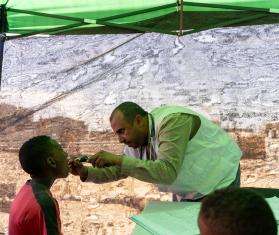
MSF supports a network of 18 reproductive health professionals in Salamabila who work within their own communities to raise awareness about the issue and the care that is available and to identify people who have experienced sexual violence. They also provide essential first aid to those who are identified within 72 hours of the attack. They refer more serious cases for follow up care with MSF’s team at Salamabila’s regional hospital.
Nurse Jeanne Musaganwa Mwavita, known to the community as Mama Jeanne, has worked for MSF for more than a decade. She stresses the importance of a holistic approach to care.
“In most cases, the women went to work in the fields and [were assaulted by] armed men,” Mama Jeanne says. “After that, it is very difficult for them to have the courage to go back to the field.” Even if it is their only source of livelihood, many survivors are too afraid to return to the location where they were attacked (67 percent of MSF’s sexual violence patients were assaulted while undertaking essential daily activities). “That is why it is so important that we not only undergo an assessment of their physical condition, but also their mental health,” said Mama Jeanne.
Compounding trauma
“Many of our patients have lost the meaning of life,” said a staff member who asked to remain anonymous. “The impact of sexual violence on psychosocial wellbeing is enormous.” Among survivors, post-traumatic stress disorder, depression, and anxiety are common, and many patients report nightmares and difficulty sleeping and taking care of themselves.
“Often, the patient does not suffer from any [specific] pathology but claims to ‘feel pain everywhere',” said Corneille Kangangila, a mental health supervisor for MSF in DRC. “Sexual violence does not only have medical consequences. It is an invisible pain. What touches me deeply is the level of violence our patients go through. The extent of the trauma caused not only by the rape itself but also by the rejection of the victim.”
A vast majority of women who are sexually assaulted are rejected by their husbands and their families if they find out about the incident. The fear of social exclusion and being abandoned by their relatives are factors that impact survivors’ decision to seek treatment. MSF staff see women isolate themselves after being sexually assaulted. “They stop meeting friends; they stop going to the market. They are afraid that if the community finds out what happened to them, they will be laughed at,” said a staff member.
Patients have also told staff they know of women who were assaulted but did not seek care due to fear of being rejected by their husbands—instead they suffer at home in silence.
Jeanne* was raped by two armed men on her way to visit her parents in the countryside of Kasai province. “When I got home and explained to my husband what had happened, he kicked me out and separated me from my three children," she said. "I am not allowed to visit them.”
Beyond emergency care
There are severe gaps in long-term support for survivors, including socioeconomic support and security and protection. “We see women who have been raped and who still endure violence and stigmatization,” said a staff member. “That’s what really bothers me. It is not the survivor’s fault; it is the aggressor’s fault. We need more protection actors here.” Lack of access to support programs can also lead survivors to “normalize” what happened, as it is the only coping mechanism available to them.
In 2020, none of the patients treated by MSF in Goma requested a medical certificate proving that they had been raped, which is essential for pursuing legal action against an attacker. The high level of impunity in DRC has made them lose confidence in the judicial system.
“Perpetrators can be arrested, but they are often released after a few days,” a staff member said. “This creates a lot of insecurity for survivors. They and their families are often threatened and left unprotected”
There is an urgent need for more effective, long-term socioeconomic support focused on survivors’ needs to help them recover and cope with adversity, social exclusion, and family abandonment. This lack of support significantly increases the suffering of survivors. It is essential that programs for sexual violence survivors be designed and funded to meet both their immediate and long-term needs.
*Patient’s name has been changed.