
The international medical humanitarian organization Doctors Without Borders/Médecins Sans Frontières (MSF) is among five non-governmental organizations (NGOs) that have filed a complaint against Italy with the European Commission (EC) outlining several examples of current Italian legislation and practices that do not comply with the European Union (EU) legal framework and endanger the lives of people who have been forced from their homes and are in search of safety. NGOs engaging in search and rescue activities in the central Mediterranean Sea, including MSF, have been continuously targeted by Italy’s harmful policies and practices designed to obstruct their work and keep people from reaching its shores since 2017.
“The European Commission is the guardian of EU treaties and has a role to play in ensuring that EU member states respect international and EU law,” said Giulia Capitani, migration policy advisor at Oxfam Italia. “It should uphold and protect the fundamental rights of all people across Europe. But instead, search and rescue NGOs are the ones filling the shameful void at sea left by EU member states. Rather than obstructing their work, EU member states should involve them in setting up a proper system for search and rescue activities."
The complaint was submitted by MSF, Oxfam Italia, SOS Humanity, Association for Juridical Studies on Immigration (ASGI), and EMERGENCY. The complaint focuses on the new Italian Law 15/2023 and argues that the law raises serious concerns regarding its compliance with EU law and the obligations EU member states have under international law regarding search and rescue activities at sea.
Preventing multiple rescues
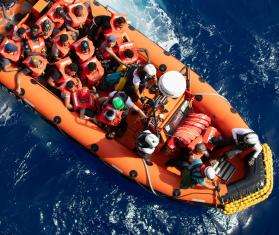
In January 2023, Italy introduced the new decree that became law in March 2023. Law 15/2023 restricts search and rescue vessels from carrying out more than one rescue operation at a time, as the legislation states that search and rescue vessels should navigate towards the assigned place of safety after a rescue operation, without delay. This implies that vessels should not provide assistance to other boats in distress after completing an initial rescue—even if there are still people at sea who need assistance.
The new law is yet another obstacle in a slew of new practices adopted by Italian authorities that are designed to obstruct and deter search and rescue, including assigning ports hundreds of miles further than the closet safe ports to disembark survivors after rescues. This policy is not backed by legislation, but has become common practice since December 2022, with search and rescue vessels frequently being assigned places of safety in northern rather than southern Italy. This significantly limits their presence in the search and rescue zone and results in people who’ve been rescued—including many in need of urgent medical care—to spend unnecessary additional time at sea

A treacherous journey
Read more“Every day we spend away from the search and rescue region—whether in detention or navigating towards a distant port—is putting lives at risk,” said MSF operations manager Djoen Besselink. “The law targets NGOs, but the real price will be paid by people fleeing across the Mediterranean who find themselves in a boat in distress.”
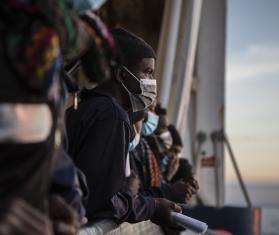
The increased journey time to places of safety in northern Italy also brings physical and mental health risks for the rescued people on board.
“Assigning places of safety more than 1,000 kilometers [about 620 miles] away from a rescue harms the physical and psychological wellbeing of survivors,” said Josh, captain of SOS Humanity’s rescue vessel Humanity 1, who wished to only be identified by his first name. “The 199 people we recently rescued, including pregnant women and babies, were forced to travel around 1,300 kilometers [about 800 miles] to disembark in Italy, although other Italian ports were much closer.”
European parliament resolution supports complaint
Today, the European Parliament adopted a resolution calling for EU action on search and rescue in the Mediterranean to save lives at sea. The resolution calls on member states to keep their ports open to NGO rescue vessels, ensure disembarkation occurs at the nearest port of safety, avoid unnecessary delays, and stop criminalizing NGOs conducting search and rescue operations.
"We call upon the European Commission and EU states to take this call from the European Parliament seriously and urgently invest in lifesaving rescue capacities," said Juan Matías Gil, MSF search and rescue representative. "The European Parliament also [emphasizes] the role of the European Commission in ensuring EU States take on their duties with regards to search and rescue, as outlined in international maritime law. The European Parliament’s resolution amplifies our call for the Commission to take action and take the necessary steps to ensure the fundamental rights of people in distress at sea are respected and the obstruction of life-saving work of NGOs at sea [is stopped]."
Drastically limiting saving lives
The five NGOs making the complaint believe that the combination of these measures puts unjustified restrictions on search and rescue operations and drastically limits their ability to save lives at sea.
"Rescued people come from countries affected by wars, climate change, and human rights violations,” said Carlo Maisano, EMERGENCY’s rescue vessel Life Support coordinator. “They are often in an extremely fragile condition, which is exacerbated by even more time spent at sea. Additionally, the practice of assigning distant ports increases the fuel costs for NGOs and depletes their limited budgets, which impacts their capacity to save lives in the future."
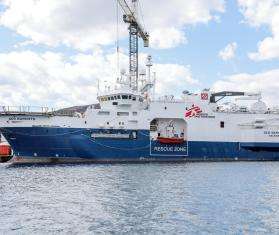
On February 23, Law 15/2023—still a government decree at the time—was applied for the first time when Ancona Port Authority notified MSF of a 20-day detention order for its ship and eventually a fine of €5,000 [about $5,500]. The penalties were imposed for failing to provide specific information that MSF had never been asked to share before.
Since then, the Italian authorities have detained four other humanitarian search and rescue vessels run by various NGOs—Aurora, Louise Michel, Sea-Eye 4 and Mare*Go—for 20 days each for violating Law 15/2023. This is 100 days that humanitarian search and rescue capacity was severely limited while dangerous crossings and shipwrecks in the central Mediterranean continued.

EU and Greece must take accountability after deadly shipwreck
Read moreMSF, Oxfam Italia, SOS Humanity, ASGI, and EMERGENCY call on the EC to put Italy’s Law 15/2023 and its practice of assigning distant ports under immediate scrutiny. As guardian of the EU treaties, it is the responsibility of the EC to ensure that EU member states comply with relevant law and stop obstructing the lifesaving work of search and rescue NGOs. Instead, NGOs should be included in state-led and proactive search and rescue capacities in the central Mediterranean Sea.
MSF has conducted search and rescue activities in the central Mediterranean since 2015. MSF’s teams have rescued some 90,000 people from boats in distress. In May 2021, MSF launched its search and rescue ship Geo Barents, which has rescued more than 8,114 people.