

Activities in 2025
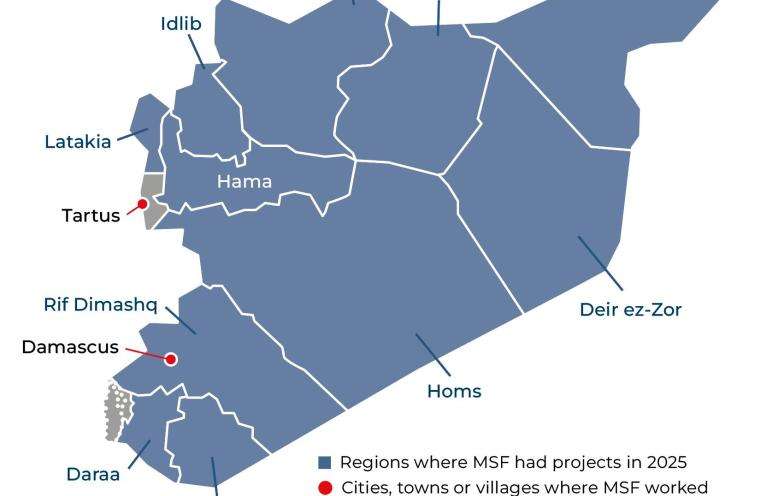
Despite relative stability in 2025, there were sporadic surges in violence in several governorates, causing further waves of displacement within the country and across borders. An outbreak of violence in Sweida forced 180,000 people to flee their homes, putting further strain on communities in other parts of the governorate, and in Daraa and Rif Dimashq (rural Damascus).
In Daraa, MSF responded by providing mass casualty kits, medical consultations, and mental health support, and by distributing relief items to displaced families. In Sweida, we supported emergency room services by donating medical supplies, carrying out rehabilitation work, and training staff, while also supplying fuel for ambulances and distributing blankets, hygiene kits, and kitchen equipment. In March, following violence in Tartus and Latakia, MSF treated patients in Jisr Al-Shughour and donated medical kits to health facilities.
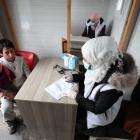
In northwest Syria, particularly Idlib, we operated mobile clinics in displacement camps, offering general, maternal, and child health care; mental health support; and treatment for chronic diseases. We also scaled up specialist care for survivors of violence from Idlib, Damascus, and Kafr Batna. In Anjara, Kafr Dael, Job Kass, Tal Hadia, and Fraikeh, we set up boreholes and pumps and trucked in water for displaced people.
At our hospital in Atmeh, we treated patients with burns, the majority incurred in accidents due to unsafe living conditions in camps.
In the northeast, fighting in Manbij, Shahba, and Tal Rifaat in December 2024 caused thousands of people to flee towards Raqqa and Tabqa. In response, MSF distributed water and essential relief items, and ran mobile clinics in Raqqa, Tabqa, and Hassakeh.
To increase access to safe water, we rehabilitated boreholes in Deir ez-Zor and Hassakeh, and operated a water purification plant in Al-Hol camp. We also continued to run our clinic in Al-Hol camp and supported others in Hassakeh and Raqqa to ensure people had access to treatment for noncommunicable diseases and mental health conditions.
Following renewed violence in Aleppo’s Sheikh Maqsoud neighborhood in September and December, which led to massive waves of displacement toward the northeast of the country, we distributed essential relief items to families.
In Homs governorate, MSF supported a general health care center by expanding sexual and reproductive health services, renovating the facility, and providing equipment and trauma kits to hospitals. We also improved services at Homs’ blood diseases center and blood bank by providing medications, training, and infrastructure upgrades. In Tartus, we donated dialysis machines and trained hospital staff.