
After months of fighting on the outskirts of Herat in western Afghanistan, the Islamic Emirate of Afghanistan (also known as the Taliban), took control of the city on August 12. A few days later the group moved into the nation's capital, Kabul, and declared that the war is over. Since the IEA consolidated power, many international donors have stopped their funding to Afghanistan, forcing health facilities to close. Doctors Without Borders/Médecins Sans Frontières (MSF) is now the only international organization working in the city of Herat. Our teams run an inpatient therapeutic feeding center (ITFC) at Herat Regional Hospital, a clinic for displaced people, and a COVID-19 treatment center. Here, an Afghan MSF medic talks about how the team kept services running both during and after the fighting, as well as the new challenges facing health providers.
Name withheld to protect anonymity.
During the fighting a lot of injured people were brought to Herat Regional Hospital. When people heard about casualties or bombings, they would get on their bicycles and go to the hospital and say they wanted to donate blood. So many people donated that the hospital announced that they had enough supplies and would call people if they needed more. I find it inspiring that during the fighting there were people running towards the hospital to help.
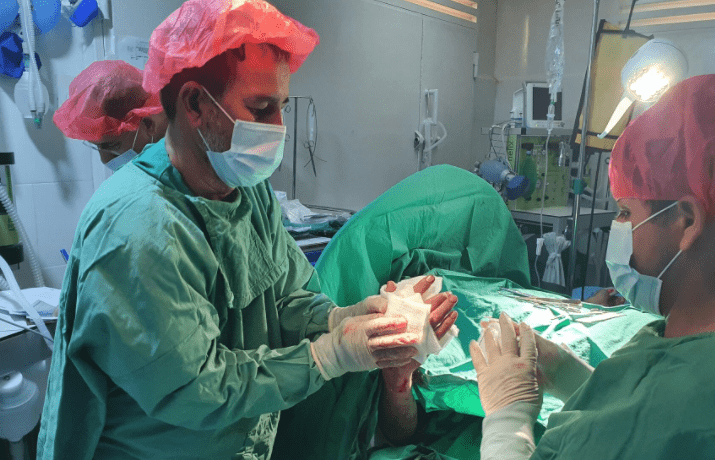
When the fighting approached Herat there was quite a lot of fear; people were worried. So was I— not knowing what would happen in the future. When the fighting started inside the city, many people were scared so [they] stayed at home. But the situation changed dramatically—in about three hours the Islamic Emirate of Afghanistan [Taliban] took full control of the city. The morning after, I went to our ITFC to help support the staff. When I reached the hospital there weren’t many people there yet—people weren’t sure if we were still open. First, we gave medication to all our patients, and then we contacted our staff to let them know the city was open and it was safe for them to come to work. After a couple of hours, we had our full team together and carried on treating patients.
Some of my colleagues told me that when they left home to come to work some of their neighbors were worried and said: “What are you doing? You have to stay at home!” [My colleagues] explained that our job is to help people, and this is the time they need help because the other health facilities are closed.
Before the fighting we had 95 malnourished children admitted in the ITFC. We only have 42 beds, and, although we added another 18 [beds] by putting up tents as temporary wards, we were still well over capacity. During the fighting the number [of children] decreased to around 60, but the numbers are increasing again day by day. [Currently] we have around 80 patients admitted.
We also run a clinic near the camps where many displaced people have settled, including from other provinces such as Badghis and Farah. The first Sunday after the takeover, a lot of patients came to our clinic as a lot of other organizations had suspended their operations, either for security reasons or because they were not able to pay salaries.
We started working with two doctors, then three, and now four. There were a lot of people coming to the clinic, one day, one of our doctors examined over 150 patients. We run a triage system—we see the people who need medical attention most urgently first.
It’s an uncertain time so people are working very hard. People are tired, but we hope it will calm down. People have hope but little idea about what the future will bring.
Now the main worry is that the other health facilities won’t be able to carry on their work. For example, those that receive funding from the World Bank, as the World Bank has stopped its funding. There’s no clear picture about what will happen. Some staff working for other organizations haven’t received salaries for months. This has happened before, but then people had hope that they would be paid eventually. Now with so much uncertainty people tell me they have no hope, and many are looking for other jobs.
There was one malnourished child in our center who was from an extremely poor family. We treated the child and provided food for the mother. We asked them how they [got] to hospital as the father told us he didn’t even have 10 Afghanis [about $0.10 US]. They [said] they sold their sheep and cows and used that money to get to hospital. Others have to borrow money from their relatives.
People are very happy when we’re able to cure their children. There was a two-and-a-half-year-old patient who came to us from Badghis—250km away [about 155 miles]. First the child was admitted in the dermatology department at Herat Regional Hospital for a skin condition. After six days they were sent to the MSF’s ITFC as the baby was malnourished—but their skin condition was still very bad. The child needed a skin graft from HRH’s surgery department, but first we treated the malnutrition.
The [whole] time the baby was with us, his father was knocking on the door asking how the child was doing. For two weeks he went back to look after his remaining children in Badghis while his wife stayed in the ITFC. When he came back, he saw that there was a big improvement. After another 10 days, we were able to discharge him.
At least once a month, the father calls to say “hi” and “Salam”, and tells us he was inspired by the treatment we gave. When the fighting started in Herat, he called [to ask] if we were fine, and he did the same after the city was taken over.
Treating patients is our responsibility. Right now, MSF is the only international organization working in Herat. Before, we were able to refer people to other health providers, but now we are the [only] option.
Compared to the time before, there is more responsibility, more challenges. There is a lot of work on our shoulders.


Story Jul 23, 2024
MSF calls on Gilead to make groundbreaking HIV prevention drug afforda...
Read More