
Nearly 70 percent of people that Doctors Without Borders/Médecins Sans Frontières (MSF) treats in the northern Brazilian state of in Roraima show signs of acute stress, depression, or anxiety as their living situations deteriorate
Since Brazil’s northern border with Venezuela was partially reopened in July, an increasing number of migrants and asylum seekers have crossed it to find themselves in the streets with precarious access to medical and mental health care, as well as other basic services like adequate shelter in the state of Roraima. That’s why the international medical humanitarian organization MSF provides comprehensive health care in two cities, Boa Vista and Pacaraima.
Pacaraima—a town of 20,000 people in Roraima state and the main entry point for Venezuelan migrants and asylum seekers into Brazil—is the first place of arrival for hundreds of people who cross the border into Brazil daily hoping to find a better life and safety for themselves and their families. It is estimated that, each day, 500 people make the journey through improvised paths called las trochas (“the trails”), while the migration office at the small border town can only process requests for legal status for 65 people—leaving the system overwhelmed and many people’s legal statuses in limbo.
“In contrast to their hopes, most people face a harsh reality,” said Michael Parker, MSF’s project coordinator in Roraima. “The people who arrive through the trochas usually stay in Pacaraima until they are able to clear their migration status, which can be a slow process.”

Meanwhile, Pacaraima’s health system is precarious and there is no infrastructure to accommodate the people arriving—leaving hundreds of men, women, and children living in very poor conditions with no access to basic health care. In November, according to the United Nations International Organization for Migration (IOM), more than 3,000 people were living on the streets because of the lack of shelters in Pacaraima while waiting for their legal status to be cleared.
“According to Brazilian law, everyone has the right to access public health services, no matter at what stage their migration status and process is,” Parker said. “But the reality is, that—even with this formal right—the actual services are overcrowded and limited in Roraima state.”
In response to the gap in health services and access to information, MSF provides medical, sexual and reproductive health, and mental health services through mobile clinics in Pacaraima and Boa Vista, Roraima’s state capital. In Boa Vista, it is estimated that approximately 2,000 people are living without shelter, according to IOM. From January to October 2021, MSF teams provided care to 37,517 patients in these two locations.
MSF saw a clear increase in the demand for our services when the border was partially opened after COVID-19 restrictions were lifted in July. From July through to the end of September, medical teams cared for 14,551 patients. Approximately 56 percent of the total number of consultations in the first nine months of the year were done during those three months. The main reasons for consultations were respiratory tract and gynecological infections. Meanwhile, the mental health team identified that 69 percent of patients had symptoms of acute stress, depression, and anxiety. The main causes were displacement, family separation, walking long and exhausting distances to reach Brazil, and experiencing violence.
“Generally, when people arrive and see us, the main questions they have are about health services and how to access them,” said Alvilyn Bravo, MSF health promoter in Roraima project. “They find themselves in a country with a completely different culture and face barriers—such as the language—to understanding how the health services work or which are available to them.”
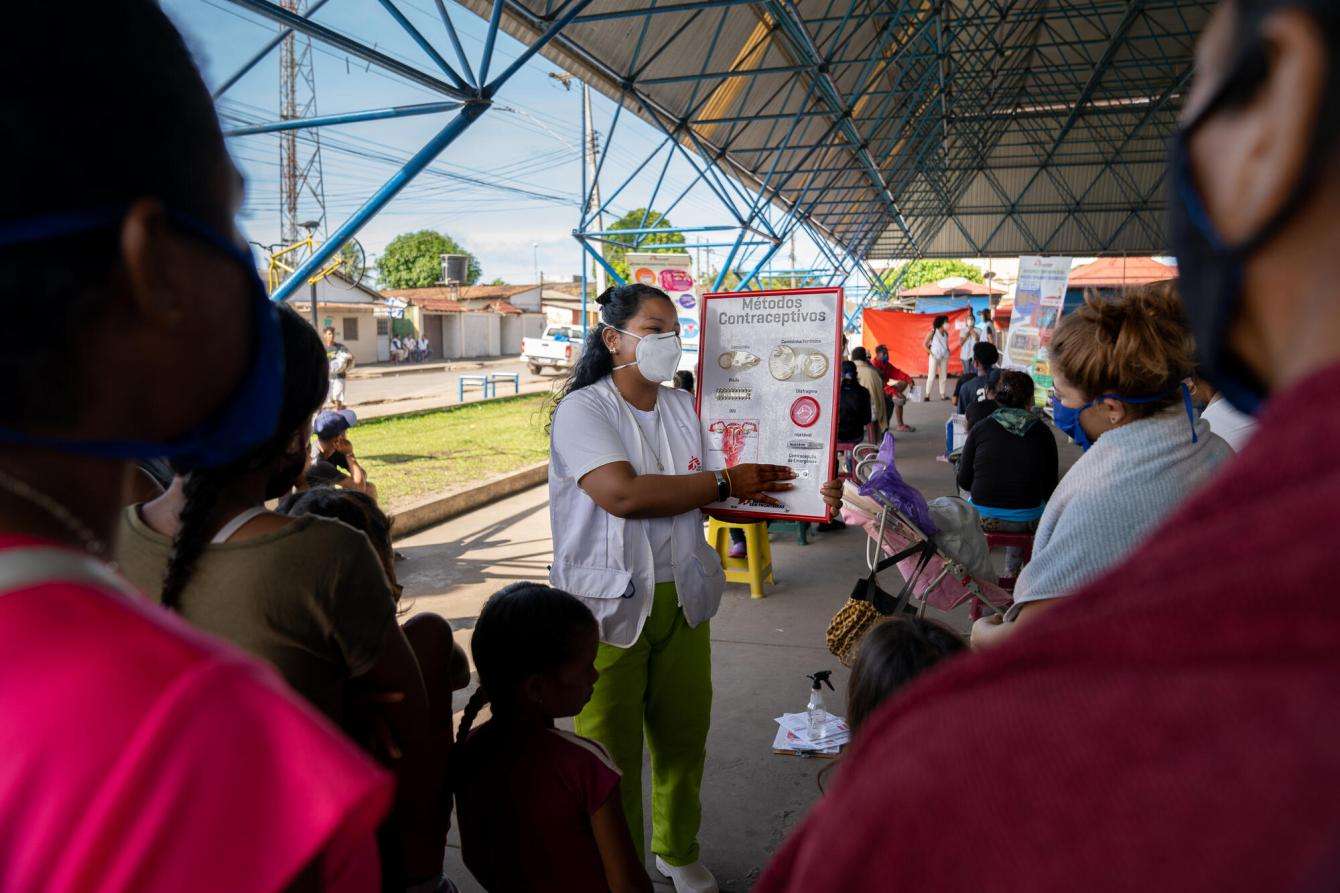
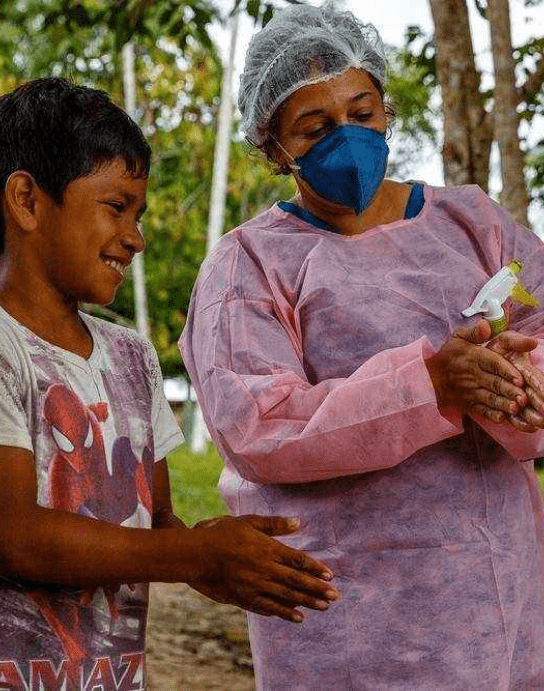
To help ensure that Venezuelan migrants and asylum seekers know which services exist and how to access them, MSF also conducts health promotion activities.
“When I arrived in Brazil two years ago, there were not as many people here as there are today,” said Alejandra, an MSF patient whose name has been changed to protect their identity. “The services I used to access when I first arrived, such as getting a doctor’s appointment, are not available today. The only health service I have is this MSF clinic. I was able to bring my daughter from Venezuela a couple of months ago. Her migration status is still not completed, and every time we go to see how her process is, the office is always full, the streets are full, and people just keep arriving.”
But even with the extremely precarious situation in Pacaraima, migrants and asylum seekers are almost unanimous on saying that they’d rather be homeless in Brazil than stay in Venezuela. “When I got here, I was sleeping on the floor on a cardboard box,” Alejandra said. “But, even so, it’s better than in Venezuela.”
“We hear stories from our patients that migrating wasn’t part of their life plan, and even consider it a last resort to escape from the financial, social, and food insecurity in their homeland,” Parker said. “During their journey, they face hunger and danger while trying to reach a safe and stable place. Despite the difficult context, we hear stories of hope and wishes of a better life.”
Every day, MSF teams witness families, women, children, and men arriving in Brazil seeking safety and searching for a better life. There must be more support for health and infrastructure, such as shelter and basic services, for migrants and asylum seekers in Pacaraima and Boa Vista.
This article has been updated from an earlier version published on 12/15/2021.
How you can help
Not everyone can treat patients in the field. But everyone can do something.
Some humanitarian crises make the headlines—others don’t. Unrestricted support from our donors allows us to mobilize quickly and efficiently to provide lifesaving medical care to the people who need it most, whether those needs are in the spotlight or not. And your donation is 100 percent tax-deductible.