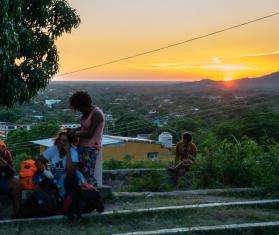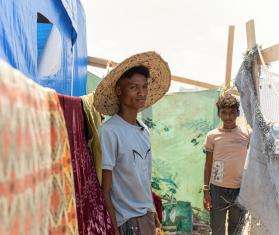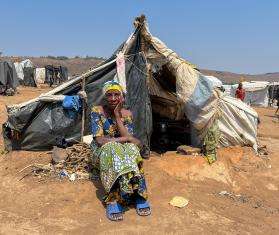

Three years after the cessation of hostilities in the Tigray region of Ethiopia, communities continue to face the devastating consequences of violence, displacement, and the collapse of essential services.
More than 760,000 people remain displaced in this region, many living in overcrowded camps with little access to food, clean water, sanitation, or shelter.
While the two-year conflict in Tigray ended nearly three years ago, thousands of people are still dealing with one of the most overlooked consequences: the psychological trauma of violence, loss, and displacement. This impact is heightened when coupled with lack of access to essential mental health care.
Living with trauma and displacement
“Life is very hard,” says Gebreyohanes, who was physically injured and displaced during the conflict. “The rain comes through the roof and floods the ground. I don’t have a proper place to sleep.”
Gebreyohanes receives mental health support from Doctors Without Borders/Médecins Sans Frontières (MSF) at Maiani Hospital in Sheraro, where MSF provides specialized care.
“Back home, I used to farm and feed myself,” he continues. “I used to sell what I farmed and make money. I was in a good place, but after I came here, I’ve been very sad.”
Gebreyohanes’ family fled to Sudan and he has since lost contact with them. Now he lives alone.
“I can’t even work and make a living,” says Gebreyohanes. “My back hurts. My knees hurt as well because of what happened to me.”
Despite receiving mental health services, which has offered him some relief, Gebreyohanes still feels the long-term impact of what he’s experienced.
“At night I still have so much stress,” he says. “When I feel physically sick, I get triggered and I get angry.”

Breaking the stigma around mental health
One of the major barriers to accessing care is the stigma around mental health. Azmera, a patient who has attended counseling sessions at Maiani Hospital for almost two years, recalls her hesitation when a nurse first suggested she meet with a counselor: “At the beginning, I was not willing. I did not think this was something good because I thought this kind of treatment was for psychiatric patients only. I also felt people would give me a bad name if I did it.”
The negative associations soon faded away: “When I come here, I feel free, calm, and good—just as water satisfies someone who is very thirsty,” Azmera says. “I have a big change now. I was not like this, especially this month. I was in very bad condition when I came here, but thanks to MSF’s support, I am feeling good now.”
Despite signs of recovery, Azmera, too, feels the lingering impact of conflict. “Even now, sometimes I experience flashbacks,” she says. “There are times when I feel good and times when I don’t; my mood keeps on fluctuating.”
Azmera’s case is part of a pattern seen by MSF staff working on the ground at the Five Angels camp for displaced people. “At first, conditions were acute,” says Helina Tsegaye, a mental health counselor who has worked at the camp for more than two years. “People came in shock, overwhelmed by what they had witnessed. Now, we see more chronic issues such as sleep disturbance, aggression, grief, and the stress from poverty, as many have lost their homes, their income, and their relatives.”
Yet stigma remains a barrier.
“We are still trying to create the awareness that seeking mental health counseling is normal. But there is still stigma,” says Tsegaye, including cultural factors related to gender. “It’s usually easier for females to talk about their feelings. For men, it’s more difficult, but awareness is slowly improving.”

Mental health care saves lives
Since resuming activities in November 2022, MSF has provided mental health care to more than 12,000 patients in Shire and Sheraro. Services include one-on-one counseling, psychological health education sessions with health promotion teams, group therapy sessions, and referrals to hospitals for psychiatric care.
In addition to mental health services, MSF also manages high-risk pregnancies, responds to disease outbreaks and neglected tropical diseases, and provides treatment for malnutrition. But mental health remains one of the most overlooked and urgent needs.
“The brain is part of the body; just as the stomach can get sick, so can the mind,” says Tsegaye. “It is important to seek professional help when needed. But without sustained support, recovery will be impossible for many.”
Ahead of World Mental Health Day on October 10, MSF calls for continued attention and investment in mental health services in Tigray. For thousands of people still coping with the scars of war and displacement, this care is not a luxury—it is a lifeline.
“Mental health care saves lives,” says Tsegaye. “It must continue.”