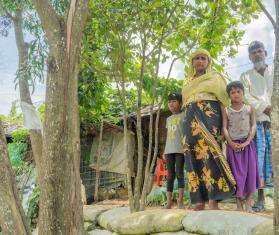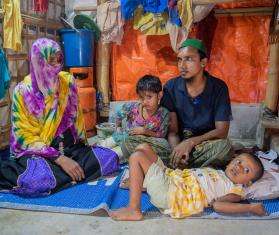

On August 25, 2017, the Rohingya people in Myanmar were the targets of a large-scale campaign of merciless violence. More than 700,000 people fled for their lives across the border into Bangladesh in a matter of weeks, joining thousands who had fled previous attacks. Today, nearly one million Rohingya still live in crowded, unsafe, and unsanitary conditions in what is now the largest refugee camp in the world in Cox's Bazar.
To mark five years of continued displacement with no solution in sight, Doctors Without Borders/Médecins Sans Frontières (MSF) gathered testimonies from people of different generations with different concerns and fears: Tayeba, a mother of five-year-old twins; 15-year-old Anwar, who misses school and wants to become a doctor; Nabi and Nasima, the parents of young children; Hashimullah, a 45-year-old former businessman; and 65-year-old Mohamed, who worked in the Myanmar government for decades before he and his people were stripped of their citizenship.
This is Hashimullah’s story.
We arrived in Bangladesh in 2017. We came here because Rohingya were being arrested and murdered in Myanmar. Our neighborhoods were burning, one after another. Bombs were dropped from planes. We observed this situation for eight days, hoping things would calm down. But things only got worse.
One night at around 4 a.m., when everyone was asleep, it started raining bullets. Everyone was scared. In the morning, we saw dead bodies floating in the canals. Some people were still alive, but no one went over to them. The military was heading towards the area where we were hiding. Everyone was scared for their lives and started fleeing wherever they could. So many Rohingya were slaughtered.
But even before 2017, men were being abducted, women were being raped, and the military was taking our livestock.
On the day we fled, a huge number of people gathered at the border. People sent boats from Bangladesh for us to cross to safety in. We were a large group. Many people drowned in the sea on the way to Bangladesh. I survived the journey and reached Shah Porir Dwip [an island in Bangladesh]. From there, we were taken to Teknaf [in Cox’s Bazar] in vehicles provided by the Bangladesh government. Local people gave us some food and money.
Then we moved to Kutupalong, where we were assigned different camps. At first, we didn’t have any materials to build a shelter with. Later, the government of Bangladesh gave us shelter materials, and we started to build them. Now, I have been here for five years.
Two years ago, I became ill. I was feeling dizzy and felt discomfort in my chest. I became unconscious and was brought to MSF’s hospital in Kutupalong. The doctor told me he found a blockage in my heart. I underwent treatment here for 16 days and finally got better.
We are suffering from many diseases here. Our shelters are still the same temporary shelters as when we arrived—they have endured extreme weather. We really need some more shelter materials, but it’s difficult to find any with the movement restrictions in the camps. Fences were put up, and we cannot move around like before.
The government provides us with some food items, and we are thankful for the things we receive, but sometimes it’s not enough, and we need to try to buy fish. Some of us worked as fishermen in Myanmar and some were farmers. We have escaped here, but our hearts are still there at home. I lived by the riverside. I had a decent living as my business was selling fishing nets and my children caught fish.
At that time, it was safe for us in Myanmar, and we could move around. But we could not enjoy our earnings because of the military. If we imported and registered five cows, we had to give them two. We had to pay 60,000 kyat [about $28 US] to the military if our daughters were to be married. If someone wished to build a house, he had to pay 500,000 kyat [about $238 US] to hire a surveyor.
Even if our hearts yearn to go back, how can we if our safety is not ensured? If the world decides that we can be [safely] repatriated, only then will we go. My only need is the right to live with dignity in Myanmar, as we are doing here. Millions of Rohingya want to enjoy their rights and to be safe at home.