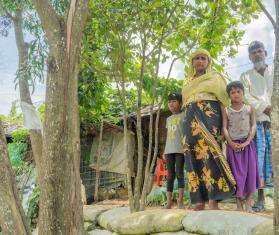

On August 25, 2017, the Rohingya people in Myanmar were the targets of a large-scale campaign of merciless violence. More than 700,000 people fled for their lives across the border into Bangladesh in a matter of weeks, joining thousands who had fled previous attacks. Today, nearly one million Rohingya still live in crowded, unsafe, and unsanitary conditions in what is now the largest refugee camp in the world in Cox's Bazar.
To mark five years of continued displacement with no solution in sight, Doctors Without Borders/Médecins Sans Frontières (MSF) gathered testimonies from people of different generations with different concerns and fears: Tayeba, a mother of five-year-old twins; 15-year-old Anwar, who misses school and wants to become a doctor; Nabi and Nasima, the parents of young children; Hashimullah, a 45-year-old former businessman; and 65-year-old Mohamed, who worked in the Myanmar government for decades before he and his people were stripped of their citizenship.
This is Mohamed Hussein's story
I graduated from high school in 1973. I even had a job as a government employee because, at the time, Rohingya were recognized under the constitution.
After achieving independence from British rule in 1948, the government accepted us as citizens. If someone's father was born in Myanmar and the son was as well, both could be recognized as citizens. People of every ethnicity enjoyed equal rights. No one faced discrimination.
This all changed in 1978, when the Naga Min or “Dragon King” census was conducted. The census determined who was a citizen of Myanmar and who was Bangladeshi. Many people were arrested for not having proper documents. Scared for my life, I fled. Later, the government of Myanmar took us back again. They made an agreement with the Bangladesh government, and we were promised if we returned, our rights would be guaranteed.
This promise was not kept. Land [was] returned to [its] owners, but our rights were not ensured. This was the beginning of our oppression. We were treated as pariahs, and gradual deprivation turned into persecution.
The authorities stripped us of our citizenship [in Myanmar]. Under the [1982] Citizenship Law, they recognized categories of ethnicity, and percentages of each were announced. This categorization had not existed before.
At this time, despite our citizenship being taken away, Rohingya were still accepted in the country as foreigners. Different regions broadcast the news of Rohingya communities. After the military takeover, our radio airtime was canceled.
We were no longer allowed to pursue higher education. Travel restrictions were imposed, and the military accused us of being involved in conflict with the Buddhists. Reputed members of the Rohingya community were arrested or fined due to allegations of oppressing the Buddhists. Curfews were enacted, and if someone was found visiting another house, he was tortured. So, we started keeping our mouths shut when something happened in our community.
Every year, they came up with new orders. The ones who failed to comply were arrested. Despite all of this, we could still vote. We elected members that participated in parliamentary sessions. Then, in 2015, even our right to vote was taken away.
We felt belittled and worried. In the country where our ancestors had been living, we could no longer vote. Our hearts sank when we were called intruders. The unjust treatment came to the point that we had to flee.
One morning [in 2017], we heard gunshots. [Then], it was a Thursday night that actual shots were fired from the military post close to our home. The next morning, we heard some Rohingya people had been killed.
When people saw the military entering our area, they started running away. We were terrified, as the military was arresting and killing people everywhere. Running for our lives, we arrived here in Bangladesh. We were fortunate that we made it here alive. Bangladesh is doing a lot for us and standing by us.
When we first arrived here, we were very hopeful. But now, we feel stuck. Life has become difficult. My heart feels restless because of this.
Whenever I go out, I am searched [by the guards]. I cannot even visit my children. One of my daughters lives in Kutupalong [a different area of the mega-camp in Cox's Bazar], and one lives nearby. It takes me a long time to reach their shelters when I try to visit them. The confinement bothers me. I feel anxious about our future because our children are not being educated properly. Whether they stay here or return to Myanmar, what will they do without education? We have many sleepless nights thinking about this.
I receive medical care for my diabetes and high blood pressure at an MSF facility inside the camp, but treatment for my kidney disease is not available in the camp. I cannot go out to get this treatment, so my hope is that it becomes available here.
I am old now and will die soon. I wonder if I will see my motherland before I die. My wish is to breathe my last breath in Myanmar. I am not sure if that wish will be fulfilled.
My heart longs for our repatriation to Myanmar, with the guarantee that our rights will be protected and that we will not be persecuted further. I am scared about the possibility of facing persecution again in Myanmar, and since our families are there, we need to think of their safety.
We would be treated equally in Myanmar if we were recognized as citizens. We should be able to study, lead our lives, and move around like any other citizen of Myanmar. We should be able to vote, participate in elections, and raise our voices in Parliament.
Now that all our rights have been taken away, we are nothing but walking corpses. The world is made for everyone to live. Today, we have no country of our own despite being human.
I am saying to the world that we are just as human as you are. As we were born as humans, we wish to live a dignified life.
We are asking the world to help us live as humans. My wish is to have rights and peace.