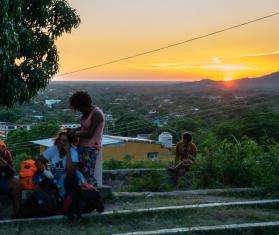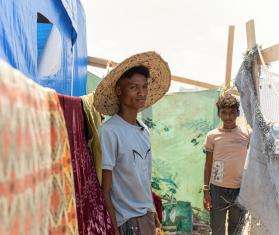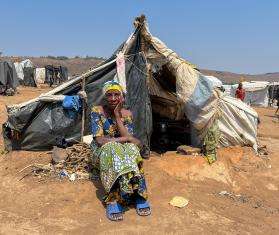

An estimated 380,000 people fled to Tawila, where Doctors Without Borders/Médecins Sans Frontières (MSF) teams received more than 300 victims and survivors of sexual violence in the five weeks that followed. Here, an MSF midwife recalls the harrowing story of a mother and daughter attacked while trying to flee: A driver was ordered to run over the mother, then moments after, the daughter was raped repeatedly by the one who gave the order.
Days that will never be forgotten
April 2025 is seared into Anna’s* memory. Anna, a midwife with 18 years of experience with MSF, was urgently called to the emergency room, where victims of sexual violence were arriving in large numbers following RSF’s assault on Zamzam camp.
“There was a smell I will never forget,” said Anna. “The room was filled with women shouting, most of them seeking care after being raped. And in the middle of it all, a girl sat in silence, barely daring to meet my eyes.”
“I asked, ‘What is happening? What is this smell?’ A woman answered, ‘There is a dead body here.’ It was at that moment that the girl finally lifted her gaze. I asked her, ‘Are you okay?’ And she replied, ‘Will you come with me so we can talk?’”

Civilians face ethnic targeting and atrocities
The girl explained to Anna that her abuser first asked if she belonged to the Zaghawa tribe.
“I denied it; the commander kept insisting,” said the girl. “My mother tried to defend me. He ordered his driver to run her over, killing her instantly, right before my eyes. After that, he took me to a place and raped me again and again.”
“It was only when he went after other people that his driver brought me back to my dead mother and the others escaping with us,” the girl added. “We placed my mother’s body on a donkey and continued our journey toward Tawila.”
Since the outbreak of Sudan’s war in April 2023, non-Arab ethnic groups, including the Masalit, Zaghawa, and Fur—many of whom survived the violence in Darfur two decades ago—have been particularly targeted. The RSF, which is besieging El Fasher and controls much of the Darfur region, dominates most exit routes from the city and attacks those trying to flee, who face the threats of rape, torture, and even killings along the way. MSF published a report detailing the situation in early July, titled Besieged, Attacked, Starved: Mass Atrocities in El Fasher and Zamzam, Sudan.

Shifting patterns in sexual violence cases
By the end of June, MSF had reinforced referral pathways through four community-based centers in displacement camps, allowing better engagement with communities. At Tawila Hospital, only nine victims received care between January and March 2025. That number rose sharply to 121 between April and June, and reached 339 in July and August. This increase is due in part to improved access to care through the strengthened referral system, and indicative of the widespread crisis of sexual violence in Darfur.
Many victims reported brutal assaults by multiple armed perpetrators while attempting to flee. Assaults did not stop with the attack on Zamzam; every week there are new episodes of violence in and around El Fasher, such as increased bombings and attacks at Abu Shouk displacement camp, followed by the arrival of more survivors in Tawila.
Anna has observed a shift in the patterns of sexual violence. “In April and May, most survivors were women and girls arriving within 72 hours of the attacks,” she said. “By August, they came forward later with support from our community centers.”
“Sexual violence against men remains largely unseen,” Anna continued. “Stigma and fear keep many silent, but there are hints during conversations and consultations when people seek care for other issues that this is ongoing.”

Protection, care, and accountability are urgently needed
Despite immense barriers to accessing medical care, over 600 survivors of sexual violence sought care at MSF-supported health facilities between April and August 2025 in the conflict-ravaged region of North Darfur.
The brutality in Darfur cannot be ignored. It must be documented and urgent action must be taken. Humanitarian donors, organizations, and all stakeholders must work to restore and scale up services provided to survivors, and strengthen protection and accountability measures. Civilians must be protected, and perpetrators of sexual violence must be held accountable.
“Survivors urgently need comprehensive, free, and timely support, including medical care, and psychological and social assistance,” said Anna. “Darfur’s survivors face relentless atrocities. The world cannot look away.”
*Name changed for privacy and security