Where we work in Sudan
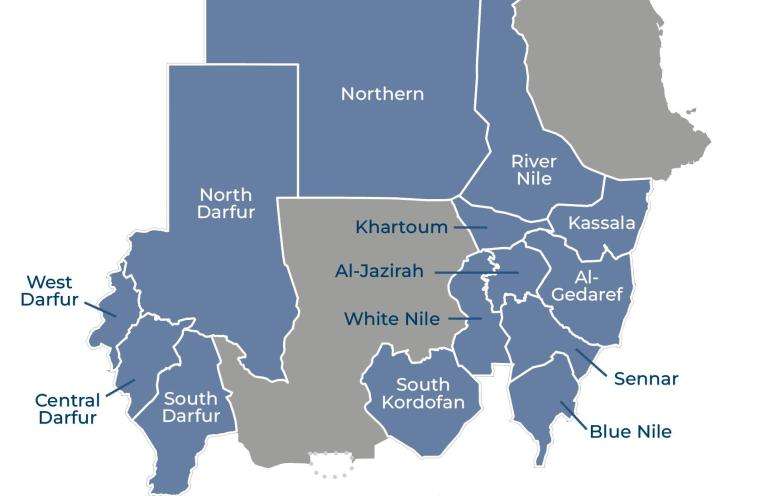
As of August 2026, MSF is running two hospitals and two clinics as well as supporting an additional 13 hospitals and 18 primary health care centers across Sudan.
Learn more about our current operations responding to the crisis in Sudan >
In Khartoum state, MSF continues to deliver essential medical services across four major hospitals and primary health centers. Our teams support emergency and surgical care, maternal and pediatric services, treatment for infectious diseases and malnutrition, and rapid response and epidemic response activities in Omdurman, Khartoum city, Bahri, and Jabal Awliya.
In Blue Nile state, we run a malnutrition ward in the main hospital, respond to epidemics, provide mental health support, carry out health promotion activities, and support primary health care in camps for displaced people. In Karama camp, which currently hosts over 110,000 displaced people, MSF provides outpatient care, reproductive health services, health promotion, environmental health activities, and supports safe drinking water access and vector control.
In Gedaref state, our teams help ensure access to emergency care, outpatient, and inpatient care, maternity services, and treatment for chronic and infectious diseases, including cholera. We also work in camps for displaced people to improve access to health care. MSF also runs two projects treating patients with kala azar, as Gedaref is a global hotspot for the disease.
In White Nile state, our teams focus on emergency preparedness and response, and on strengthening community surveillance and referral pathways to help people reach care quickly during outbreaks. Our team is also supporting two rapid response teams with alert investigation, early diagnosis, and case management or referrals to health facilities.
In North Kordofan state, after months of negotiating access with the authorities, MSF launched an emergency response in El Obeid, the state’s capital. This followed an assessment in late 2025 which identified huge health and humanitarian needs. Since re-entering El Obeid in July, we have been assessing health and water, sanitation, and hygiene needs in the main hospitals and displacement camps, with a particular focus on sexual and reproductive health, pediatric services, cholera response, and mass casualty planning.
In South Kordofan state, MSF launched an emergency intervention based in Abu Jubeiha in June. We are also rehabilitating the local hospital’s emergency department and plan to position staff and support emergency care. In addition, MSF will play an integral role in outbreak response in the state.
In Central and West Darfur states, MSF supports four hospitals and a primary health care center with a comprehensive package of care, including in Zalingei and El Geneina, two cities that have been heavily affected by the war and displacement. In Central Darfur, MSF is present in Rokero, a hard-to-reach area in the north of the Jebel Marra mountains. where our teams provide emergency and inpatient services, maternity care, treatment for malnutrition and common childhood illnesses, responses to cholera and measles, mental health support, and assistance for survivors of sexual violence. In some areas, MSF also provides surgery and supports outpatient consultations to expand access to health care for remote communities.
In North Darfur state, reported drone strikes have intensified, increasing risks for civilians and complicating humanitarian access. MSF operates a 200-bed hospital in Tawila, providing emergency, maternal, pediatric, mental health, nutritional support, and surgical care, and supports a general out-patient department. Our teams also distribute water and provide care for survivors of sexual and gender-based violence.
MSF also plays a critical role in responding to outbreaks, including cholera and measles, and is currently the only organization on the ground in the area with the operational capacity for a large-scale epidemic response. In recent months, MSF teams have supported three primary health care centers in Dobo, Katur, and Belsharif.
In South Darfur state — where very few international organizations are present — MSF supports Nyala Teaching Hospital with pediatric emergency and inpatient care, neonatology, and inpatient malnutrition care for severely malnourished children with complications. We also provide primary health care, nutrition, care for survivors of sexual violence, sexual and reproductive health care, and other community-based services in and around Nyala, including areas hosting large numbers of displaced people. In Kas and South Jebel Marra, MSF supports hospital and primary health care services, including for emergencies, pediatrics, maternal health, nutrition, sexual and gender-based violence, and sexual and reproductive health care, while also providing services and conducting outreach activities in remote communities. MSF has played a significant role in revitalizing water systems in South Darfur, repairing infrastructure including heavily damaged water networks and community-based hand pumps. We also have an emergency unit in Darfur, which responds to urgent crises like disease outbreaks and provides critical services to people who are newly displaced.
MSF activities in 2025
Throughout 2025, MSF worked across war-ravaged Sudan, delivering lifesaving assistance to people exposed to atrocities and critical shortages of water, food, and medical care. Despite attacks on our facilities and access restrictions, we continued to deliver a wide range of medical services to communities that have been affected by the ongoing war. The humanitarian situation in Sudan remains catastrophic. While the warring parties bear primary responsibility, the limited aid response and the global failure to prioritize the protection of civilians and humanitarian access have exacerbated people’s suffering. Although some progress was made on bureaucratic hurdles during the year, such as cross-border access to Darfur through Chad, it was often impossible to secure visas and travel permits in the east of Sudan, or crossline access, in a timely manner. In some cases, we were deliberately blocked from treating people in need; for example, in North Darfur, the RSF’s siege forced us to halt activities for patients already in the grip of famine in Zamzam camp.
Cholera and other disease outbreaks
In 2025, MSF continued to tackle the worst cholera outbreak the country has experienced in recent years. While cases subsided in some states, such as Northern and Kassala, they rose in White Nile during the first half of the year, following strikes against a power plant in February that put pumps out of service and forced people to rely on contaminated water.
Cholera cases exploded in Khartoum in May, and spiraled out of control in Darfur in August. In response, often in partnership with other aid organizations, our teams set up or expanded treatment centers and oral rehydration points, distributed clean water, donated medical and logistical supplies, and improved sanitation and infection control in affected areas.
There was also a steep rise in measles cases across Darfur due to a lack of routine and reactive vaccination campaigns. We increased our capacity to isolate and treat measles patients and conducted several vaccination campaigns while calling on the authorities and health partners to take urgent measures to curb the outbreak. Many of the children we treated were suffering from acute malnutrition on top of measles, increasing the risk of developing life-threatening complications.
To strengthen child immunization, our teams coordinated vaccine supplies and improved cold chain systems. Across the country, we also treated people with malaria, dengue, diphtheria, and whooping cough.
Widespread attacks against civilians and health care
No one was safe from the fighting, as both warring parties frequently hit residential areas, markets, aid convoys, and hospitals. Our teams assisted with mass influxes of injured patients in emergency rooms in Khartoum, Nyala, Tawila, and other locations. Our vehicles and places where we operate were also targeted during the year. On January 10, one of our ambulances came under fire in North Darfur while referring a woman in labor, resulting in the death of a caregiver. In August, a Ministry of Health staff member was injured during an armed assault inside Zalingei Hospital, where our teams were working. This was followed by another fatal shooting of a Ministry of Health staff member in the same facility in November.
In 2025, North Darfur and the Kordofans were epicenters of extreme violence and mass killings as the SAF and RSF battled for control.
In Zamzam camp, North Darfur, we had to halt all our activities in February due to escalating attacks and a siege that prevented us from sending in supplies and staff. Following a large-scale RSF assault on the camp in April, we provided emergency and surgical care in the nearby town of Tawila. As people continued to flee the violence in and around El Fasher and seek refuge in overcrowded camps in Tawila, we significantly scaled up our response, distributing food and water, expanding health care services, and setting up a 250-bed hospital.
According to the UN, at least 6,000 people were killed in three days during the RSF’s capture of El Fasher. In the weeks that followed, we assessed the displacement situation in various locations across Darfur and made efforts to locate and help survivors. We also offered comprehensive care to hundreds of victims and survivors of sexual violence.
At the end of the year, following increased security risks, we had to withdraw from Kornoi, Um Baru, and Tina, where we had been running medical and humanitarian services.
In South Kordofan, we provided urgent medical care and relief items such as jerrycans and hygiene kits to displaced people in five camps in the Nuba Mountains. At times, however, bureaucratic delays and restrictions prevented us from reaching communities in dire need of medical support in both North Kordofan and South Kordofan.
In Khartoum state, we resumed our activities at Bashair and Turkish hospitals in May, after being forced to suspend operations in the facilities for months due to repeated security incidents. Hundreds of thousands of people started to return to the capital city in the second half of the year, often finding their homes destroyed and basic services collapsed.
Health care for mothers and children
In response to the needs of mothers and children, in 2025 MSF focused on strengthening prenatal and inpatient care, referrals, and nutritional support in Nyala, Tawila, and Zalingei. We also treated children with malnutrition in the hospitals and clinics we support, including in the malnutrition ward we run in Ad-Damazin, Blue Nile state. Originally designed to accommodate 36 beds, the ward expands to as many as 170 during the peak season. Yet even outside peak periods, it rarely returns to its intended capacity due to the high demand for inpatient care.