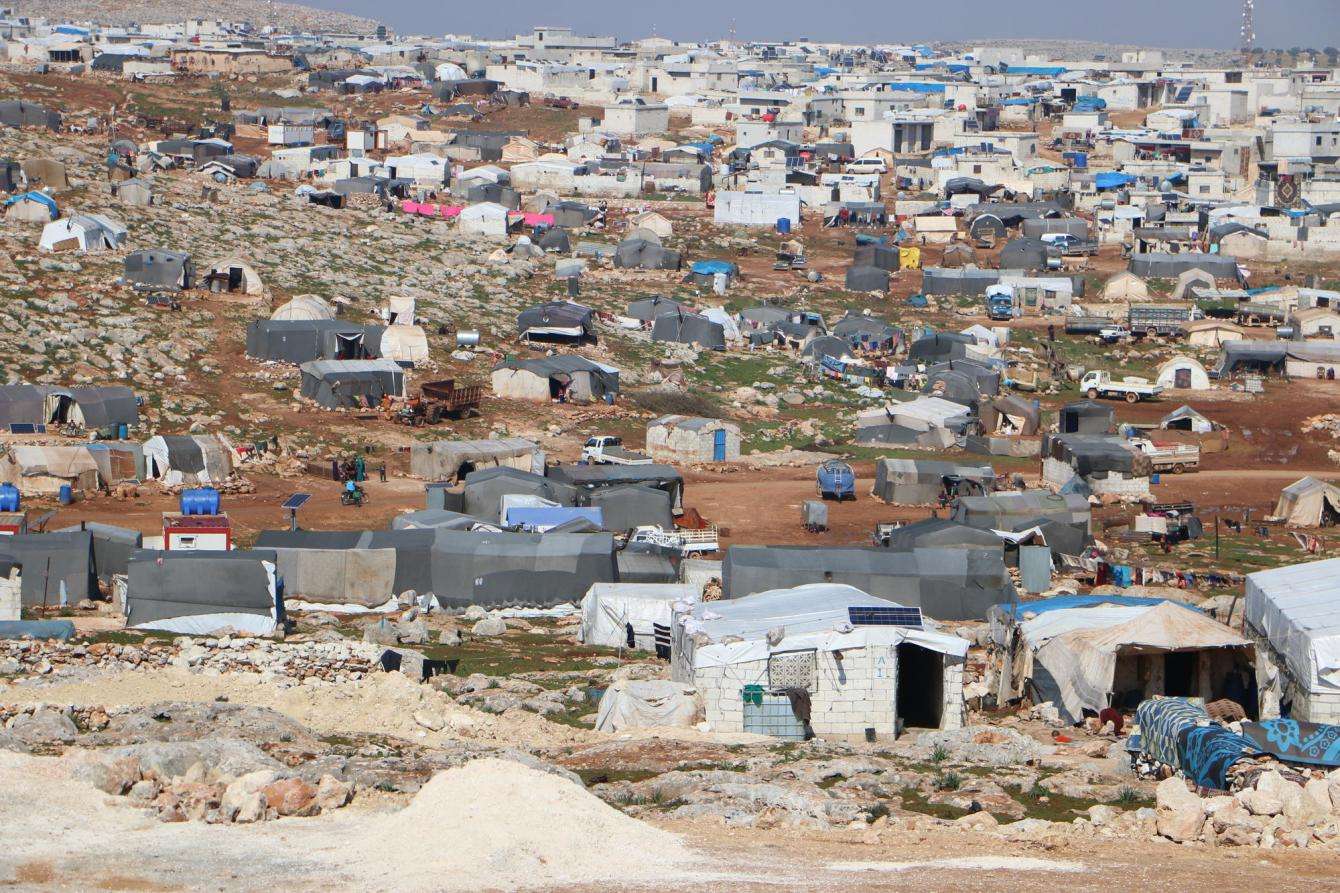
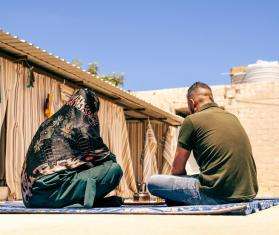
"New people are arriving in the area, but they’re not coming to Deir Hassan camp, because here it’s full," said Dr. Mustafa Ajaj who worked at a primary health center supported by MSF in Takad before he was forced to flee with his family. "Instead they’re setting up their tents two or three kilometers away. People are dependent on aid, but there just isn’t enough to go around.
On February 27, MSF began distributing 300 tons of compressed wood fuel blocks to more than 20,000 people. Distribution will take place over the next two weeks in 23 displacement camps in northwestern Syria to provide a safer alternative to current heating methods. Recently a family of four died of suffocation after burning poor quality fuel to heat their tent.
People urgently need other essential items to protect them from the cold, such as blankets, mattresses, and warm clothes. MSF teams are currently organizing a supply of tents and relief items for 800 families.
MSF plans to significantly scale-up its activities in northwestern Syria in the coming weeks, including distributing essential relief items such as tents, cooking sets, floor mats, and blankets. MSF is also planning to provide trauma care and to reinforce basic healthcare for the displaced. But MSF’s ability to increase its assistance depends on the Turkish authorities facilitating the movement of supplies and international staff to the area across the Turkish border. MSF currently has no international staff present in northwestern Syria and many of its Syrian staff are exhausted and need support after years of working in extremely difficult conditions.
MSF has no permanent presence in Turkey. To be able to scale up our response, MSF asks all relevant Turkish authorities to immediately facilitate the transit of staff and essential supplies into northwest Syria.
Since the conflict intensified in northwestern Syria in December 2019, MSF has provided more than 260,000 gallons of clean water per day to about 41,000 displaced people, built more than 100 latrines in camps around Sarmadah area, and distributed survival relief items to 2,000 families.
In February 2020, MSF teams also distributed 600 non-food item kits, including blankets, winter clothes, and hygiene kits to displaced people in camps and several informal settlements in Maraat Misrin and Killi areas in Idlib governorate.
MSF has also provided donations of emergency medical supplies to hospitals on the front lines of the conflict.
Across northwestern Syria, MSF teams provide maternal health care, general health care, and treatment for non-communicable diseases (NCDs) through mobile clinics. MSF teams distribute relief items and improve water and sanitation systems. They also support regular vaccination activities in two vaccination centers, one hospital, and through mobile clinics.
MSF also runs a specialized burn unit that provides surgery, skin grafts, dressings, physiotherapy, and psychological support. MSF provides remote support to primary and secondary health care to several hospitals and clinics around Idlib and Aleppo, and has co-management partnerships with three hospitals.