
Though more people are now able to seek medical care without risking dangerous journeys across front lines, Afghans still face facing widespread instability, mass displacement, and the disruption of basic services, including health care. Many public health workers have not been paid in months, and stocks of essential supplies and medications are running low or have been exhausted.
Throughout the upheaval in Afghanistan this summer, Doctors Without Borders/Médecins Sans Frontières (MSF) continued to run much-needed medical care across all five of our projects in Herat, Helmand, Kandahar, Khost, and Kunduz provinces. As the situation evolves, we are continuing to adapt our projects to meet the massive needs.
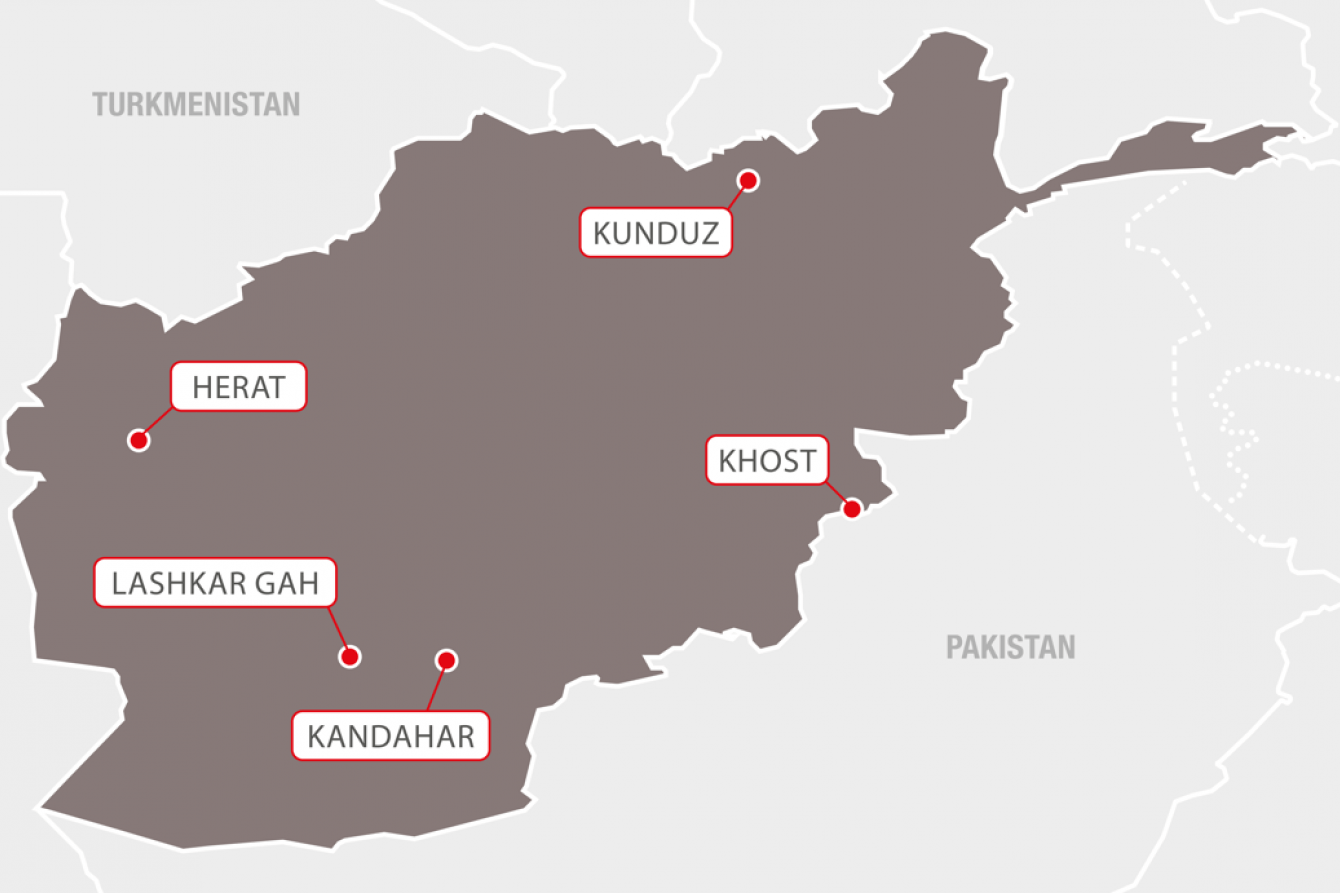
MSF operations in Afghanistan
Herat: Medical facilities exceeding capacity
Governmental health care staff and those working for other organizations in Herat have not received salaries for months. Many Ministry of Public Health staff are looking for work in private clinics, in addition to their regular jobs, to make ends meet.
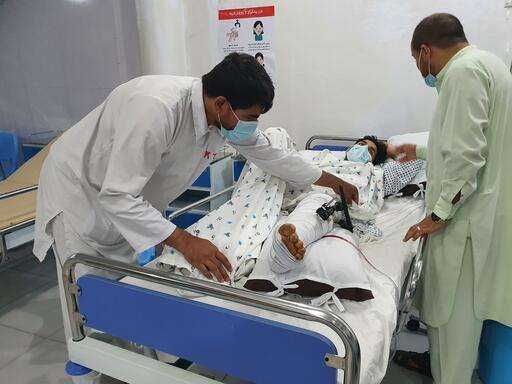
The third wave of COVID-19 is on a downward trend, but MSF is working on preparing for the inevitable fourth wave. Vaccination coverage remains low. Discussions to increase the capacity of the MSF COVID-19 treatment center to 100 beds are currently underway.
Our inpatient therapeutic feeding clinic (ITFC) at Herat Regional Hospital is facing a critical situation. The facility was initially set up with 40 beds, but to cope with the seasonal increase in malnutrition we set up temporary wards in tents outside to increase capacity to 60. The number of hospitalizations has, however, now reached 200 percent of our bed capacity.
Based on seasonal fluctuations we normally would have expected the number of admissions to the ITFC to decrease by now, but instead we are consistently admitting between 90 and 100 children every day. This is most likely a result of the lack of functioning health services in the area, the economic downturn, inflationary pressures in the marketplace, and persistent drought conditions. MSF teams are installing insulated containers to increase capacity and to prepare for the winter, which is fast approaching.
On the outskirts of Herat, MSF continues to provide outpatient care, treatment for noncommunicable diseases, and sexual and reproductive health services at the Kahdestan clinic. Once the fighting ended, we witnessed a significant increase in people coming to the clinic—up to 400 patients per day, compared to 300 per day in July—as other health care providers in the area suspended their activities. These numbers are now going down as other providers return and reopen, reflecting the slight increase in the availability of health services.
Key figures (September 6–12, 2021)
- The Kahdestan clinic provided more than 1,900 consultations, including 111 for prenatal care (48 of which were first prenatal consultations). Children under five accounted for over 25 percent of all consultations, mostly for acute watery diarrhea and respiratory tract infections.
- Over 60 new ITFC admissions for the third week in a row.
- 695 suspected COVID-19 cases triaged at the Herat Regional Hospital, an average of around 100 per day. This number is down from nearly 300 per day during the peak of the third wave.
Kandahar: Mobile clinics and ongoing support for patients with TB
During the fighting, MSF was able to continue its care for drug-resistant tuberculosis (DR-TB) outpatients by providing remote consultations and buffer stocks of medication to prevent patients from having to cross front lines to access care. TB care continues today and we have a small number of inpatients being treated in our DR-TB center. At Mirwais Regional Hospital, MSF is screening patients for TB.
In early September, the team launched a mobile clinic for people living in informal settlements near the border with Pakistan, in the town of Spin Boldak. In the last two weeks they have provided 540 consultations, nearly half for children under five. The majority of people present with respiratory infections, diarrhea, and gastrointestinal problems. On September 14, water trucking and chlorination activities were underway to help provide clean water.
Key figures (September 6–12, 2021)
- 33 DR-TB outpatient consultations for follow-up and contact tracing. Four DR-TB inpatients receiving treatment in our TB center.
- 131 patients screened for TB at Mirwais Regional Hospital.
- 540 consultations through mobile clinics at Spin Boldak
Khost: MSF maternity hospital expands its intake criteria
MSF’s Khost maternity hospital previously focused on treating women with complicated deliveries but is continuing with its widened admission criteria to ensure that pregnant women from across Khost province have access to the medical care they need to give birth safely. We are seeing an increase in patients and deliveries each week.
Private clinics are seeing significantly fewer patients than a month ago, likely a result of the deteriorating economic situation which makes the cost of care prohibitive.
MSF supports eight comprehensive health centers (CHCs) run by an organization that is funded by the World Bank, which has suspended its funding to Afghanistan. This lack of funding means that the people running the CHCs are unable to pay personnel or buy medication and supplies. Staff continue to work but it is getting more and more difficult.
Key figures (September 6–12, 2021)
- 481 admissions to Khost maternity hospital
- 407 deliveries
- 35 babies admitted to our neonatal ward
Kunduz: Shortages of staff and medical supplies
We are continuing to gradually expand the capacity of the Kunduz Trauma Center, which opened earlier than initially planned. We are mostly seeing people who were injured in road traffic accidents and people injured by the fighting who have complications.
The health system in Kunduz continues to be strained as experienced medical staff leave the province, including senior health administration officials. The staff who remain have not been paid for several months and often come to work for only a few hours a day. Medical and logistical supplies are still scarce, and the main regional referral hospital continues to rely on donations from the few humanitarian actors that retain some presence in the country.
Key figures (September 6–12, 2021)
- 153 patients triaged in the trauma center
- 102 patients treated in the inpatient department
- 34 surgical procedures
Lashkar Gah: An influx of patients
The hospital in Lashkar Gah remains very busy, and on some days our emergency room receives around 800 patients. The 300 inpatient beds are full. This high number of patients is in large part caused by the fact that other facilities are not, or hardly, functioning—including those funded by the World Bank.
This was already an issue during the fighting in August, but with the suspension of international funding the situation keeps deteriorating. Another contributing factor to the large influx of patients is that people who couldn’t reach the hospital without crossing front lines can now more safely access health care.
Key figures (September 6–12, 2021)
- 5,387 emergency room consultations (around 770 per day)
- An average of 77 malnourished children receiving treatment in the ITFC each day
MSF is a medical humanitarian organization operating under the principles of independence, impartiality, and neutrality. Since the 1980s, MSF has provided medical care throughout Afghanistan in areas under the control of a variety of political and armed factions. In Afghanistan, MSF relies solely on private funding and does not accept funds from any government for its work.
MSF'S FOCUS ON Afghanistan: Crisis update September 22, 2021
Though more people are now able to seek medical care without risking dangerous journeys across front lines, Afghans still face facing widespread instability, mass displacement, and the disruption of basic services, including health care. Many public health workers have not been paid in months, and stocks of essential supplies and medications are running low or have been exhausted. Throughout the upheaval in <a href="https://www.doctorswithoutborders.org/what-we-do/countries/afghanistan">Afghanistan</a> this summer, Doctors Without Borders/Médecins Sans Frontières (MSF) <a href="https://www.doctorswithoutborders.org/what-we-do/news-stories/news/afghanistan-medical-needs-urgent-ever-after-taliban-takeover">continued to run much-needed medical care</a> across all five of our projects in Herat, Helmand, Kandahar, Khost, and Kunduz provinces. As the situation evolves, we are continuing to adapt our projects to meet the massive needs.
Learn about our work on Afghanistan: Crisis update September 22, 2021

News Jul 26, 2024
ViiV must urgently help get more people on lifesaving HIV prevention m...
Read More