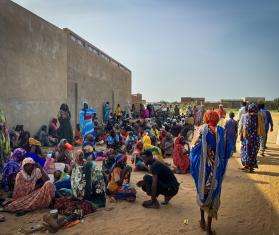
"They're being moved into camps where there's not yet access to water," said Trish Newport, MSF's head of emergencies. "These are camps in the middle of the desert. There's no shelter, there are no latrines. And people don't have anything with them. With conditions like this, we are extremely concerned about disease outbreaks, which could occur if the humanitarian response is not urgently scaled up."
Malaria cases have sharply increased with the onset of Chad's rainy season, and people are at increased risk of contracting waterborne diseases such as cholera.
How MSF has responded so far
Health needs are already high in camps where MSF works, such as Camp Ecole in Adré, which now hosts 150,000 refugees. MSF supports a 250-bed pediatric ward at Adré hospital and runs a 38-bed clinic in Camp Ecole, as well as an ambulance service for patient referrals. The clinic is continuously full, with staff carrying out 400 consultations per day and seeing a high level of malnutrition. Some patients cannot continue their treatment for malnutrition because they are rapidly being relocated to other camps, making it difficult for the MSF team to track them.
MSF has so far installed three borehole wells at Camp École and delivers clean water by truck to multiple camps, but the needs are far greater than what MSF can meet alone. In Ambelia and Ourang camps, people are forced to begin lining up for water at 2 a.m. due to a dire water shortage.
Services strained under increasing needs
Before the conflict in Sudan began, Chad was already host to more than one million refugees and internally displaced people. The significant increase in refugees arriving from western Sudan this year is straining the available resources. Food prices have gone up in Adré, and most of the new arrivals cannot afford to buy food. This situation also affects local communities, as their cost of living has risen while incomes remain stagnant.
There is a crucial need now for international resources to address the humanitarian needs in eastern Chad. MSF appeals to the international community to urgently provide shelter, food, water and sanitation, health care, and protection services for the thousands of people fleeing unspeakable violence, who have lost their homes, livelihoods, and loved ones in Sudan.