
A renewed offensive by the armed group M23 in South Kivu province, Democratic Republic of Congo (DRC), has led to a new wave of refugees fleeing to neighboring Burundi.
Of the more than 88,000 people who have arrived in recent weeks, about 37,000 have settled in Ndava transit site, where Doctors Without Borders/Médecins Sans Frontières (MSF) set up a mobile clinic and is providing clean water and sanitation support.
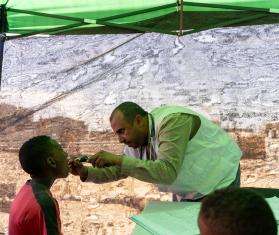
MSF’s team at Ndava transit site is treating an average of 200 patients each day in our mobile clinic, and referring complicated cases to Cibitoke District Hospital with ensured continuity of care. Our team is also providing 25,000 liters of water per day and building latrines and showers to reduce the risk of diseases associated with lack of access to basic hygiene needs.

Cholera, malaria, and measles pose threat to refugees
Since the beginning of the year, thousands of Congolese refugees from North and South Kivu provinces have crossed the Rusizi River into Burundi amid escalating fighting and insecurity in DRC. Many have taken shelter in schools, sheds, churches, and stadiums, in addition to camps like Ndava.
“The camp is saturated,” says Zakari Moluh, MSF project coordinator. “You can see a few families sharing the same tent, and the ground is covered in mud. We see people holding 2-liter water bottles—this is all they have to cover their needs. Food is almost unavailable. We fear the health and humanitarian situation will worsen.”
Living conditions are dire, with makeshift shelters offering little protection from the elements, people sleeping on the ground without blankets, and not enough food to eat. The overcrowding has further heightened the risk of diseases like cholera, measles, and malaria.


From left: MSF teams build latrines and showers at Ndava transit site; inside MSF's mobile clinic in Ndava, where teams treat refugees and refer serious cases to the district hospital in Citiboke. Burundi 2025 © Dorine Niyungeko/MSF
In Ndava, 42 percent of malaria tests have come back positive in recent days. Malaria has long been the leading cause of hospitalization and death among young children in Burundi, where geographical, climatic, ecological, health, and socio-economic factors all contribute to its endemic nature and scale.
To address these threats, MSF is scaling up its emergency medical response across the country, with support for cholera and measles treatment, vaccination, and water and sanitation. Our teams support a 50-bed cholera treatment center as well as sexual and reproductive health care and treatment for survivors of sexual violence, which are also among the primary health needs.

Living with uncertainty and urgent needs
As the political and security situation in DRC evolves rapidly, refugees are living with uncertainty. Many are in a state of distress, despair, and exhaustion as they wait to be relocated to the east of the country, where more than 29,000 have arrived at Bweru camp, a long-term site.
“We see people in a state of distress, despair, and exhaustion,” says Moluh. “We see women who gave birth while fleeing, some who give birth in our clinic.”
The Burundian authorities and international humanitarian organizations are providing assistance to the refugees, but the needs are overwhelming. Humanitarian organizations must immediately mobilize to provide vital health care and other essential support.