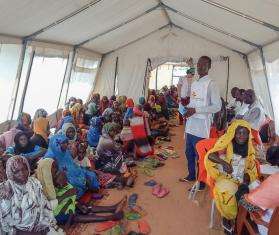

Two weeks ago, we saw some of the most severe fighting since the start of the conflict. There were airstrikes and heavy artillery shelling taking place around the Armoured Corps army base which is about three miles southeast of where the Turkish Hospital is located. We have faced mass casualty arrivals many times—in the last four months, there have been at least 17 major offensives to try and take control of this base. So, the situation is very dangerous for those who live nearby. Life is very hard, including in the hospital, but everyone on the team is conscious that our presence is crucial for the people of Khartoum.

Sudan: Daily power cuts with life or death consequences
Read moreAccess to health care remains the biggest challenge
The biggest challenge of providing health care in Khartoum remains access. There is extreme insecurity, almost zero transportation, and it is very difficult for patients to get to the hospital. There are no ambulances. Any vehicles that go out are commandeered by the armed personnel who control the streets. Even vehicles owned by MSF have been stolen. We have faced several security problems over the past few months.
Currently, at the Turkish Hospital, MSF has only one rental vehicle with one courageous driver who is able to bring in medicines as well as food and water for our patients and staff. However, this is no easy task. There are multiple checkpoints on the roads, and at each one we need to explain our presence, the type of assistance that we are delivering, and why it is crucial that we are able to continue the supply chain to the hospital.
Because there are no ambulances, patients have to find their own way to get to the facility, and they have very few options. Before the war, Khartoum was a well-organized city with a functioning ambulance system and many people had their own vehicles. But today they have been obliged to adapt to the new reality. Their vehicles have been stolen, or even if they still have them in their possession, they are worried about using them to get to the hospital because they know they could be taken from them on the way. The only vehicles that are able to move freely are those used by the combatants.
Another reason you don't see many vehicles in the city is because there is a city-wide fuel shortage. We see dozens and dozens of vehicles that have been abandoned at the side of the road because they have run out of fuel and become useless after being stolen. People have begun using wooden donkey carts again—or they simply come by foot. Some patients told me that they had walked over 10 miles and crossed the frontlines to reach us.
Maternal health and the collapse of Khartoum’s health system
Although the emergency room at the Turkish Hospital sees many patients with war wounds during escalations in the fighting, the original purpose of the hospital is to provide health care for sick children and pregnant women, and this has not changed.
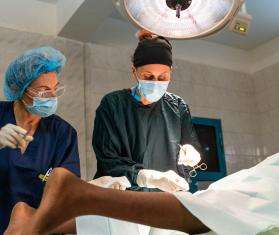
There are an average of eight deliveries per day in our maternity department, and an average of three Cesarean sections. Most of the women are still in good health, but some have anemia, and lack of blood is a challenge when it comes to performing Cesarean sections. Blood needs to be stored at a very specific temperature, and it is a major challenge to maintain this due to the ongoing fuel and electricity shortages in the city. Bringing in new medical supplies is also becoming more difficult because travel permits are no longer being issued regularly, and this prevents our teams from being able to enter Khartoum to restock the hospital.

Living and working on the front lines of a brutal conflict in Khartoum
Read moreAt the beginning of the conflict, there were huge efforts to connect women with midwives so they could continue to receive health care during pregnancy and childbirth despite the fighting. WhatsApp groups were created to give advice to pregnant women, and they were a lifeline for many. Unfortunately, it has not really been possible for this kind of support to continue as the violence has increased. Many health workers have left the city due to the fighting, and this means that initiatives like the WhatsApp groups have unfortunately fallen by the wayside.
Sadly, because of the circumstances of the war and the lack of staff, activities such as prenatal care, vaccinations, and follow-up care for women and children post-delivery have not been available in southern Khartoum since the beginning of the conflict. The health system has almost completely collapsed in Khartoum and there are no primary health care activities, with the exception of one health center that has re-opened in our neighborhood, and a group of Sudanese volunteers trying to provide care in a nearby mosque. We hope that in the health center, prenatal and post-natal care, as well as vaccination activities, will be organized again. But for now, these types of activities are almost non-existent. We are only able to provide the most urgent forms of health care—safe deliveries, emergency Cesarean sections, and intensive care for children who are very sick.
On the horizon: Cholera, malaria, and malnutrition
Due to the lack of vaccinations, we are concerned that there will be an outbreak of measles or meningitis in the coming weeks. Cholera is also a very real risk because of the lack of drinkable water and poor sanitation. Fortunately, there is not a huge concentration of people in Khartoum like there was before the war, which may reduce the risk a bit, but the reality is that there are no vaccination activities, there is no clean, drinkable water available, and there is a lack of sanitation and hygiene.
We have an average of 15-20 children receiving inpatient treatment in the pediatric ward at the moment, and two to three new admissions each day. The teams who worked at the Turkish Hospital before the war have noticed that the number of children coming with diarrhea and dehydration has increased, which was not a common problem before the war, but it is due to the poor water quality. Additionally, despite the hot weather, there are a significant number of children with pneumonia and the causes, most likely, include the lack of vaccinations as well as poor sanitation conditions. With the arrival of the rainy season, we can also expect an outbreak of malaria in the coming weeks.
A worrying number of children are being admitted with severe malnutrition, considering the fact that we are not actively detecting malnutrition in our outpatient department. Some children are malnourished because of lack of food, while others are malnourished as a result of another diseases.
When a child has malnutrition in combination with other diseases—like malaria, diarrhea with dehydration, and acute respiratory infections such as pneumonia—their condition can become critical. We already have a few cases of severe malaria, and among newborns we have a significant number with septicemia, or blood poisoning. Although we have enough beds at the moment, when the malaria season starts—and if the number of children needing treatment for severe malnutrition increases—we will not have enough. Additionally, there is currently no space for an isolation ward to treat children if they get measles, so we foresee many issues and we are trying to find solutions.

Sudan: MSF calls for visas for surgeons, nurses, and other staff
Read moreWhat’s next: Care for chronic diseases
We are one of the few health structures providing care for patients with chronic diseases such as diabetes, asthma, and cardiovascular diseases. We have many older patients with complications. For example, sometimes we see older patients with diabetes who arrive in a coma due to being unable to get insulin because of the war. Because they have no access to treatment in the city, they get very sick, and they reach us in very poor condition.
One positive note is that in Khartoum, the mortality rate in the hospital is under two percent, which is a big success for the medical and logistics team considering the conditions they are working under. Despite the problems they face every day—the lack of electricity, water, oxygen, and sometimes specific medications for anesthesia and for blood transfusions—we have been able to maintain our team and continue to deliver emergency health care for the people of Khartoum.
Nevertheless, people are very pessimistic. The majority I have spoken to think that the war will continue for many more months—even years.
About MSF in Sudan
MSF has been responding to the crisis in Sudan since it began in April and is currently working in 10 states: Khartoum, Al-Jazeera, West Darfur, North Darfur, Central Darfur, South Darfur, Al-Gedaref, Blue Nile, White Nile, and River Nile. The MSF-supported Turkish Hospital in southern Khartoum is the only hospital in the area that is able to provide specialized health care for pregnant women and sick children, and the only one with functioning pediatric and maternity wards. MSF also provides maternal health care in northeast Khartoum and in Omdurman, in addition to other regions in Sudan.