This article is part of a developing story.

See latest updates

Aid for Gaza must be urgently scaled up, not blocked

MSF is committed to continuing our medical and humanitarian assistance, despite Israel’s March 1 deadline for 37 NGOs to leave Gaza and the West Bank.

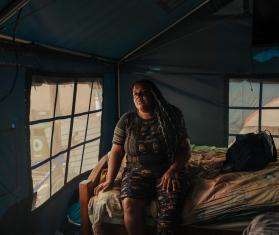
A mother and her malnourished child wait for care in Gaza.

Donia and her 1-year-old, Ahmed, wait to be seen at MSF's clinic in Gaza City. Both she and Ahmed have malnutrition. | Palestine 2025 © Nour Alsaqqa/MSF

Despite sustained violence and persistent aid restrictions imposed by Israeli authorities, Doctors Without Borders/Médecins Sans Frontières (MSF) is committed to continuing our assistance for people in the Occupied Palestinian Territory — including Gaza and the West Bank — for as long as possible. We continue to work under our registration with the Palestinian Authority.

People need a massive scale-up of lifesaving assistance and unhindered humanitarian access after more than two years of war and amid an ongoing catastrophe in Gaza. This includes amputees in need of consistent physiotherapy, people who can't shake respiratory infections because they're living in flimsy tents this winter, and children who have gone through such severe psychological trauma that it has stunted their development.

We call on Israeli authorities to enable humanitarian aid at scale and on the international community to ensure Palestinians in Gaza and the West Bank are not abandoned to their fate.

Christopher Lockyear, MSF secretary general

“MSF is working to preserve services for patients in an increasingly constrained environment,” said Christopher Lockyear, MSF secretary general. “The needs are immense and drastic restrictions have deadly consequences. Hundreds of thousands of patients need medical and mental health care, and tens of thousands require long-term medical, surgical, and psychological follow-up.”

Under international humanitarian law, as the occupying power, Israeli authorities are obliged to ensure the provision of humanitarian assistance. Yet restrictive new rules, which require 37 NGOs to leave the Occupied Palestinian Territory by March 1, threaten to drastically reduce the already insufficient aid. 

Israel's High Court announced today that it has granted an interim injunction to temporarily halt the ban of aid organizations working in Gaza and the West Bank. This decision comes after 18 nongovernmental organizations, including MSF, filed a joint petition arguing that Israel's sweeping new restrictions risk disrupting lifesaving services and causing irreparable harm to civilians. The impact of the court's interim order remains unclear.

Despite the US-led peace plan, Israeli authorities continue to heavily restrict — and even deny — Palestinians access to water, shelter, and medical care. Living conditions remain undignified, and Palestinians continue to be killed and injured amid ongoing violence. In the West Bank, there have been alarming increases in violence, forced displacements, armed settler attacks, home demolitions, settlement expansion, and obstruction to health care.

Thousands of tents in Al-Mawasi, Khan Younis, where displaced families live in overcrowded conditions and lack the most basic necessities for survival.
Thousands of tents in Al-Mawasi, Khan Younis, where displaced families live in overcrowded conditions and lack the most basic necessities for survival. | Palestine 2025 © Motasem Abu Aser/MSF

The withdrawal of MSF’s registration with Israeli authorities is already impacting patient care, as deregistration compounds the strain on a health system that has been devastated over the past two years, and constrained by persistent restrictions on essential medical equipment and supplies. Since the beginning of January, Israeli authorities have prevented MSF from bringing international staff and additional supplies into the Occupied Palestinian Territory. Under existing regulations, all of MSF’s international staff would be forced to leave Israel and the occupied territory by March 1. The supplies that have been blocked from entering include surgical equipment, antibiotics and pain medications, and sterile gauze for war wounds.

MSF’s medical programs are already facing shortages, and our medical teams are particularly concerned for their ability to continue to provide emergency trauma care and rehabilitation services to patients, as well as pediatric care, sexual and reproductive health services, and treatment for non-communicable diseases and psychiatric conditions. In the longer term, MSF’s activities will be uncertain and potentially impossible to maintain under such restrictive conditions. People will die without access to essential medical care.

The needs are immense and drastic restrictions have deadly consequences. Hundreds of thousands of patients need medical and mental health care, and tens of thousands require long-term medical, surgical, and psychological follow-up.

Christopher Lockyear, MSF secretary general

“MSF’s programs are critical lifelines,” Lockyear said. “Medical care and humanitarian assistance on this scale cannot easily be replaced. Amid ongoing humanitarian catastrophe, MSF will stay in the Occupied Palestinian Territory for as long as possible, doing as much as we can. We call on Israeli authorities to enable humanitarian aid at scale and on the international community to ensure Palestinians in Gaza and the West Bank are not abandoned to their fate.”

MSF has been working in the Occupied Palestinian Territory since 1988, providing medical and mental health care, as well as large-scale water and sanitation services. In 2025, MSF supported 1 in 5 hospital beds in Gaza, assisted 1 in 3 deliveries, carried out 913,284 outpatient consultations, and distributed more than 700 million liters of water. In January 2026, MSF provided 83,579 outpatient consultations and treated 40,646 emergency cases and 5,981 patients for trauma-related conditions. In response to overwhelming needs, MSF had planned to expand its programs in 2026 with a budget of $153 million (€130 million). That support is now shrouded in uncertainty.

How MSF is responding to the war in Gaza