More than 1 million Rohingya people live in Cox’s Bazar, Bangladesh — the world’s largest refugee camp complex. Despite growing needs, the humanitarian response in Bangladesh has been constrained by decreased international funding, and living conditions remain dire in the camps, raising the risk of outbreaks and other health issues.
Doctors Without Borders/Médecins Sans Frontières (MSF) provides a range of specialized health care services to address the vast health needs of the camp residents, including treatment for non-communicable diseases like diabetes.
In this episode of the Humanitarian Lens podcast, Dr. Anjoli Anand, who leads MSF's work on non-communicable diseases, speaks with host Elias Primoff about how people with diabetes in Cox’s Bazar must deal with not only overcrowded conditions and limited access to electricity but also the stigma surrounding the disease.
ELIAS: The refugee camps in Cox's Bazar in southern Bangladesh host close to a million Rohingya people, most of them displaced by horrific violence and persecution in neighboring Myanmar since 2017. Stranded in the camps with little hope of returning home, they are totally dependent on aid. In a place like this, the health needs might seem obvious: clean water, food, and vaccines.
Less obvious is insulin. Inside the camps, MSF cares for more than 2,000 people living with diabetes and high blood pressure. I'm Elias Primoff, your host for this episode of the Humanitarian Lens, a podcast from Doctors Without Borders/Médecins Sans Frontières (MSF). I visited those camps in May. My guest today was there before me. Anjoli Anand leads MSF's work on non-communicable diseases (NCDs).
Anjoli, thanks for being here.
ANJOLI: Thank you so much for highlighting this underappreciated topic. I'm really excited to talk about it.
ELIAS: I want to start with your experience. This is a context that I think a lot of listeners might not be familiar with. What's it like to visit the camps in Cox's Bazar? Take me back to the first time you went into the camp.
ANJOLI: I think one thing that's really important to know is that prior to the emergency in 2017, this area was a national forest. It was a national park. When the mass migration of people occurred in 2017, this was not a place that was set up to host a displaced population.
It's incredibly hilly. It's very forested. And so when you're approaching the camps as they exist today, the first thing you're sort of struck by is just the beauty of the place. There are farmers in the surrounding area. It's rice paddies all along the dirt roads to the camps. But then you reach the camps themselves, and you're first sort of struck by the fact that they are completely enclosed.
There's quite a lot of violence that occurs within the camps. Some of it is related to non-state actors from the Myanmar side and conscriptions. And so, as a result, there is bamboo fencing encircling the camps. They've maintained a lot of the forestry, because there is a hope within Bangladesh that someday this can return to being a national park.
This means that there are no permanent structures within the camps, except those related to camp management by the government of Bangladesh. All of the NGOs and other actors are not permitted to build permanent structures. So there's a lot of bamboo structures; homes are typically made of bamboo covered in tarp.
This can make it very difficult to improve access, to make things walkable. Like I said, it was quite hilly. This is a very rainy part of the country, and the monsoons every year bring a lot of rain. It’s also very humid, so there's often algae growth along brick pathways.
For very elderly patients coming for a non-communicable disease service, it can be dangerous for them to walk, up and down very slippery brick or dirt paths. Often these people are walking three hours or more to come to their clinic visits, because there is no motorized transportation permitted within the camp or any wheeled transportation.
Even bicycles are prohibited. The most you can do is sort of a carried chair. And sometimes we have some of our patients with mobility difficulties who access the clinic that way.
ELIAS: You're painting a really vivid picture. You mentioned how enclosed this camp is, and I think it's important to make clear that it's not just that it's enclosed, it's that people can't leave. The people who are stranded in these camps are stateless, these are people who have no home to go back to in Myanmar. But they are refugees in Bangladesh and are really not permitted to leave.
It's difficult to overstate just how challenging it can be to get around in a place like this and the scale and density of it.
ANJOLI: I almost fell during my visit, and when I went it was the rainy season. It was incredibly hot, humid, and wet. We had already been hearing about landslides. And on my way down it wasn't actively raining at that point, but clearly was slippery enough that I did almost fall right over.
Thankfully my colleague Tareq, who is our medical activity manager, was there to catch me. And I think pretty soon thereafter they did power wash those bricks. But you can imagine that in parts of the camps beyond MSF's purview, that's not really an option. And so for a lot of our patients, it's incredibly difficult.
ELIAS: You were meeting with patients while you were there, talking about their experiences. Do you have patient stories that stand out from your time there? Anybody who really sticks in your mind? Stories you might have heard?
ANJOLI: When I was in Bangladesh, we did make a series of visits to patients’ houses all throughout the different camps. I was most struck by a young lady who was 17 or 18 at most. The family had agreed ahead of time that we could come. We had said we were interested in hearing about what it's like to be a young woman with Type 1 diabetes living in this sort of a place.
We were welcomed into their home. Like you said, they're these small bamboo structures, [with] very low ceilings, often dirt floors — if you're lucky, concrete — often one, maybe two rooms.
They're not very large. And we go into the space, take our shoes off, and they're inviting us to sit down on these mats. But in the middle of the room is a young lady just lying on the floor.
I'm an emergency room doctor by background, and my one skill set is to know sick or not sick. That's the first thing that I do when I see somebody. And those red flags were going off immediately. This was a very sick person and the family was not reacting at all.
We were trying to probe what's going on, [asking], “When was the last time she had insulin? When's the last time she ate? How long has it been like this?” They were explaining she hadn't had insulin for some time, and that they hadn't been able to go to the clinic, and were hoping maybe they could find something else.
We were really trying to emphasize she's very unwell and needs urgent care. But the other thing I'll just say is that they're living in such extreme circumstances, that at some point, you become a little inured to how far things have gotten with someone's health or the conditions you're living in, and you become burnt out by the experience.
And I think that's what was happening in that home that day. We spent about an hour with that family, emphasizing that we really needed to get her to the hospital. And finally, in the end, they did agree. And they had called some neighbors for support to carry her there because, of course, she couldn't walk.
Like I said, there's no transportation. We then continued on our way, and we notified the hospital that she would be coming so that they were ready for her. By the time we made it back to the hospital at the end of day, she had arrived.
She was immediately admitted to the ICU and started treatment for diabetic ketoacidosis. The next day, we went to go see her in the hospital. And at that point, she was fully conscious, speaking, and looking so much better.
She said, “You look really familiar. Were you in my home yesterday?” She had no real understanding of what had been going on around her, and so I think that was just a really extreme example of what it can be like. Especially for young women with Type 1 diabetes, this is not so unusual because she was unmarried and there are difficulties in finding a husband. If it's known that you have Type 1 diabetes, families will try and hide that kind of information, and that can often lead to not going to all your follow-up appointments. We do see this sort of not infrequently.
ELIAS: There are whole generations of people who have grown up in these camps, who have spent their lives living in crisis. I think that's important to acknowledge, and the story is just such an obvious example of that. Walk us inside a clinic. What do you see when you get there? What do you hear? What is the environment like?
ANJOLI: Our new clinic is a much more enjoyable experience for our patients. We now have nice high ceilings, and it is an open space. When you first arrive, there's a waiting area where health promoters deliver all sorts of health education messaging. They are local community members who have relationships with the people who are coming to us seeking care. It's really important patient support work that these key staff members do.
When you go to the registration desk, you'll be triaged whether you need just general outpatient services or because you have a skin infection or a cough and you want to have that checked out.
If you are a member of our NCD cohort, meaning that we follow you over a long period of time, you're enrolled in those services, you'll go in one direction. And we do have a dedicated health education program for NCDs, acknowledging that the sort of wraparound services that are needed for people with chronic diseases can be quite extensive.
There is the medical treatment that [patients] receive, but they often need counseling and mental health support because there is always a risk of anxiety and depression tied to some of these conditions. But then you can imagine if you're trying to manage them in such precarity, it's even more difficult, so we make sure that they have access to the mental health care services.
Health education is also critical, because they're trying to make choices about what to eat among very limited options. And so how can they support their medical journey with the few resources they have? We make sure that there are educators available to help them work through some of that.
ELIAS: Can you speak more about stigma associated with diabetes in this setting, and also the work that MSF does to try to counteract that?
ANJOLI: Absolutely. I think it surprises people that there is so much stigma associated with non-communicable diseases, especially people who live in higher income countries, where these are kind of matter of fact, everybody knows people who have things like epilepsy or diabetes.
In the contexts where we work, not only in Bangladesh, I hear the same stories in South Sudan, Syria, and Central African Republic, with respect to both diabetes, epilepsy, these kinds of conditions, that there is a lot of stigma and social isolation.
There is also a lot of fear, both associated with managing a disease like this, about the long-term outlook for their lives and how to how to integrate when they need many accommodations. For Type 1 diabetes in particular, we're doing quite a lot of different things and we come at it from lots of different angles.
Part of it has to do with the products that we use for the care itself. In low- and middle-income countries, typically if you want insulin, you're purchasing it in a private pharmacy. It typically comes in a vial and you have to buy a syringe because this is the most affordable form.
In high-income countries, I don't think anyone has seen a vial of anything in a long time. Insulin pens are what most people are used to using in high-income countries. We're starting to, as standard practice, prescribe people insulin pens in these contexts as well, which are easier for them to use, but even more importantly than that, they're discreet.
Patients can take pens with them to work and school, and can inject themselves throughout the day as they need to, in a very discreet manner. The other thing that we try to do with health promoters or other community members, is messaging. Sometimes that will be in schools, on the radio. It looks a little bit different everywhere we are.
The third key thing that we're starting to finally do is to include people with lived experience in these activities from the beginning. In Bangladesh, we have started a peer support program this year. We've recruited people who live with diabetes and also other conditions, including epilepsy and hypertension. We're also forming support groups so that our patients can kind of meet each other and offer the kind of support that we don't think of.
We're not the ones who have to inject ourselves four times a day. We're not testing our blood sugar throughout the day. We're not the ones who have to explain to family members during a wedding celebration, “I actually can't have that. I'm so sorry.” Right? So how do they negotiate these sorts of real-world conditions? They're the ones who are the experts; they know best. We're really trying to incorporate more of that.
I think that really has a huge impact on the stigma, because it shows patients and caregivers that a full life is possible. We're hearing that from a lot of our patients once we've started to put these groups together. In the Central African Republic, we have a patient association that formed when we started with these new insulin pens and self-testing products because they realized, “I can go to school now, I can go to work now. I can actually see that there is a life for me in 25 years.” And so I think that does quite a lot of the anti-stigma work as well, just because of the sense of confidence that they also have in moving through the world.
ELIAS: What have you learned from those health promoters and patients about how they live with conditions like diabetes?
ANJOLI: There are so many tips and tricks about how to do the mundane day-to-day things. In Dagahaley refugee camp in Kenya, in Dadaab, the mental health manager, Gabriel, is living with Type 1 diabetes. He's there for the mental health team, but he is a person with lived experience, and we've invited him to be part of our technical working group within MSF at the headquarters level, because we find his experience so valuable.
He has just done so many educational webinars and things for us where he passes on messages I would never think of.
Many patients are afraid to check their blood sugar, because if that number is really high, there's this sense of shame that can come with that. He'll share tips like, what's something that brings you a lot of joy? Is it singing? Is it dancing? Are there certain people who make you feel safe and comfortable? Can you do some of that before you test? Can you do your testing with a trusted person with you nearby?
If you have a fear of injection, he's the one who tells us what it feels using a pen versus a syringe. With self-testing, he started to explore continuous glucose monitors, whereas we have fingerstick glucometers. And he's giving us great feedback about what it's like to not have to prick your finger a couple of times a day. If you can just run a scanner across a [sensor] patch, what does that mean for his day-to-day life? Just a lot of very practical tips for how to get through a day.
ELIAS: I saw a lot of this when I was lucky enough to meet with patients in Cox's Bazar. One thing that I really appreciated was how people who are doing home care for diabetes are connected with a buddy, and for a lot of people, that buddy ends up being a family member: an aunt, an uncle, a brother, or sometimes even a child. I heard this a lot from some older patients who were just nervous about needles.
It was really special to see these relationships between parents and often children who are just like, “OK Mom, I've got this. I can help you with this. I know how to do it.” And how grateful those patients were, not just to be getting that safe care at home, but also to be getting it from somebody that they trusted and knew.
Diabetes is challenging to treat in a setting like this for any number of reasons. We've covered a lot of them already, but maybe one of the most fundamental ones you mentioned earlier is that it's really hot in Cox's Bazar, and insulin needs to be refrigerated. How is the team tackling that?
ANJOLI: This is a huge challenge pretty much everywhere MSF works — our patients very rarely have access to home refrigeration. In some places, we might suggest that patients look to their community to see what kind of storage options are available. Sometimes people have found a store that has a refrigerator that has some reliable electricity access, maybe a backup generator, and the proprietor will allow them to store their insulin there.
That's not an option that is available to the majority of our patients, so we really did have to find a solution if our goal was to allow people to self-inject safely at home. The alternative to self-injection at home is that our patients are being asked to come twice a day to a clinic, every single day, for an injection, and that is still the norm in humanitarian contexts. Most patients are required to come daily to the clinic.
You can imagine that very few people actually do come twice a day, and that means they're being underdosed. Those who do come twice a day have no time for work, school, or any other thing that makes a fulfilling life.
[Safe storage] really was something that we had to prioritize because we would not be able to move forward on this topic without enabling people to store insulin at home safely. We did some studies on the sort of storage needs of insulin to begin with. The manufacturers kind of give us a very narrow range of temperature that insulin can be safely stored at.
And we thought, “Well, OK, that's the label. What is it in real-world conditions?” We did do that research several years ago and showed that actually insulin has a much wider range of temperature that it tolerates for at least four to six weeks, which is great because that buys us a lot more time.
It's very different to have to go to the clinic twice a day than to have to come once a month. That's a much more doable thing. There's some research out there about a host of different ways that people store insulin at home, comparing all of them. The one that seems the most adaptable is really looking back at ancient technologies, when people were trying to store vegetables at home for longer periods or keep water cool. They often stored these in clay pots because they were widely available, and these products that are often found in the local market almost everywhere we are.
We looked to clay pots to see how we can support insulin storage through this method, and now in most of our projects we distribute clay pots to patients who are taking insulin.
It works by evaporative cooling; a wet layer of sand in between two pots is pulling the heat away, keeping the inside cool. [Patients] store their insulin inside these pots, and for about a month they're able to self-inject at home. And now they're able to go to school, go to work, meet their friends, and have a life.
ELIAS: Food is an everyday concern, even if you are not diabetic, as a refugee living in Cox's Bazar. In May of this year, the World Food Program (WFP) rations had been cut drastically, as much as 50 percent for some people who were living in the camps. This was already a pretty meager supply that had then been cut again.
The relationship with diabetes for so many patients is very much a relationship with food, whether it's too much, not enough, or the wrong kinds. Would you tell us more about how people navigate that in a setting like this, where food is already so fraught and complicated?
ANJOLI: This is the most difficult part. We can bring insulin, we can do self-testing, but food is really the big barrier. For somebody with diabetes, food is medicine. If you don't have enough food, you can't take insulin. Or at least as much insulin as you perhaps need. If you get that mismatch between insulin and the food that they can have, then you are at risk of going into ketoacidosis, or having low blood sugar, which can be catastrophic.
It is really is top of mind for our patients all the time. We've started doing qualitative surveys of our patients who live with diabetes across several projects, and this is the common theme that is emerging across all of them: food access.
They're really happy to have access to the commodities, and they're able to learn how to use them pretty quickly. I say that just because often, one of the things you hear as resistance toward introducing some of the newer diabetes products [is the question of whether] patients with poor health literacy or poor numeracy skills will be able to engage. And it's absurd. Of course they can.
We show that every day. But the food problem, that's a lot harder to fix. In our projects we do try to supplement where we can. In some places where MSF works, we're starting to bring on social workers who can do assessments both to look for other partners who provide food aid or to help us identify who are the most vulnerable within our cohort so that we can then supply food.
There's a challenge there, of course, because our patients live in families, and often in many of our projects, these are large families. You might have one child with Type 1 diabetes who is one of eight children plus the parents, potentially some grandparents in there. You really have to take a whole-family approach when you're doing an intervention like this, because you know that food is going to be divided.
We do try and look for partners. WFP is often the provider of food aid in the kinds of places we work. They are experiencing massive budget cuts, and that aid is being reduced.
I will also note that WFP has categories of particularly vulnerable patients that they might target, [including] people living with HIV and people living with tuberculosis. We are not at a point yet in diabetes advocacy success where diabetes is seen as one of those qualifying conditions, so some of our advocacy will be related to that, to really highlight the need to strengthen food support for these patients. In the meantime, other than supplementing where we can, we also try and think about how can we adapt their insulin regimens to make them more flexible.
The only way to do that is to introduce these newer kinds of insulins that are much more commonly used in high-income countries. But of course, those insulins are more expensive. That's the other piece of our advocacy, to try and bring those costs down and show that there is a role for these insulins in these sorts of places, specifically, with even tighter food insecurity.
ELIAS: And I think one thing that's lost often is that people who are living through a crisis, whether it is an immediate crisis like a natural disaster or a more protracted one, like the situation of so many of the people in Cox's Bazar, they have all the same health needs that people who are not living in crisis have.
They may have diabetes, cancer, or high blood pressure, and all of these non-communicable diseases don't go away in the face of an urgent emergency. Where do you feel that this work fits into MSF's emergency response work, and what does it mean to consider non-communicable diseases an emergency in the sense that it's something that MSF responds to?
ANJOLI: These conditions exist in all of these places. In fact, the massive growth that we are seeing in prevalence across the world is being driven by growth in low- and middle-income countries. Sometimes in the acute emergency phase, that might just mean making sure that prescriptions stay filled and just doing prescription refills and that's it.
What we have seen in our projects is that increasingly over time, these are what people are seeking help for. And so that sort of experience, which we've seen kind of across the MSF movement, really is one of the catalysts for providing more organized NCD care and chronic disease care in general because we know that this is what people are asking for, and we're in a very privileged position as an organization that we can make our programing decisions based on what the people are asking for, whether this is part of some larger agenda outside of the organization.
ELIAS: I would love to hear about how you got into this work with MSF, and why you feel it's important that it be included on our list of priorities.
ANJOLI: I'm an ER doctor by training, so I thought I was ready for combat zones and trauma response and that kind of thing. During my residency and after, before I joined MSF, I did so much additional coursework on tropical diseases.
I have ASTMH [The American Society of Tropical Medicine and Hygiene] certification. I did that test, it's incredibly difficult, thinking that I was going to go in and work on cholera, on malaria. I worked in the malaria branch at the CDC as an Epidemic Intelligence Service officer so that I could be ready when I finally joined MSF for what I thought the needs were.
Then I went to Tigray in 2021, in Ethiopia, during the early months of that war. We were so ready for a trauma response, we had so many trauma kits in our supply closet, and that's not what we were seeing.
Every so often we would get patients who were in a road traffic accident, but more than anything else, I saw patients lined up outside the outpatient clinic with a history of hypertension or diabetes looking for services. On the inpatient side, I saw so many young adults with Type 1 diabetes who died because of a lack of insulin access. Insulin was a product that was not making it across the border into that region at the time.
At that time within MSF, we were not ordering it ourselves. I could see within an organization how at the headquarters level we weren't seeing what the full needs were at the project level and sort of that disconnect.
From the patient experience level, I saw so many family members who were just so desperate for access to this thing that they had easy access to just a couple months ago. Tigray is a place where, prior to the conflict, their health system was very robust. People had really strong health-seeking behaviors. They knew what they had, they knew what their treatments were, and they were used to following up.
All of a sudden that was cut off, and so they were in really desperate circumstances. And they were looking for us to find a way, asking, “Is there anywhere you can refer us to?”
But there was no insulin in surrounding hospitals either in the capital of the region. When I came back from that assignment, that activated me at that moment, like “OK, this is something that I have to work on.” And within six months MSF posted this as an interim position to cover a parental leave.
I said to myself, “Let me give that a shot.” And that was four years ago.
ELIAS: You found your niche.
ANJOLI: Found my niche.
ELIAS: Thank you again for this conversation and your perspective. Before we come to a close, what is the one thing you want someone who has maybe never considered this issue before to understand and to take away from this conversation?
ANJOLI: The people who live with diabetes in these sorts of circumstances can do so much if they just have the tools. There is so much bias about what they're capable of. A lot of the people with the funding who make the decisions about what kind of care to offer [have] a real misunderstanding and a lack of appreciation that our patients are smart. They know what they need. If they give them the tools and some good education, they can absolutely do it.
We are seeing that across the board in South Sudan, Central African Republic, Syria, Bangladesh, and Lebanon, that if you just give them good tools that are easy to use, even if you ask somebody to inject themselves four times a day and to prick their finger four times a day, they will do it because they see that they feel better afterwards.
This is not as complicated as we make it out to be.
ELIAS: Thanks for tuning in. If you liked what you heard today, please subscribe, leave us a five-star rating, and drop a review. It really helps other people find the show. Until next time.
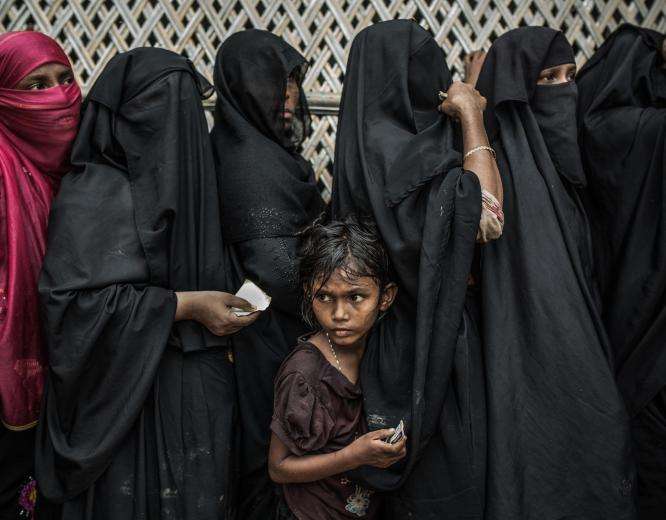
A timeline of the Rohingya crisis
Years after the mass exodus of Rohingya people from Myanmar, their future looks as uncertain as ever. Learn more about the history of the crisis.