You naturally might think of doctors when you hear the name Doctors Without Borders/Médecins Sans Frontières (MSF) — but behind every consultation, surgery, and vaccination campaign is an entire logistics and supply chain operation making that care possible.
On any given day, MSF logistics teams make sure projects have what they need, and try to anticipate what will be needed in the future, no matter the weather or political climate.
Urshula Edwards, an MSF supply chain coordinator, has worked on several MSF projects, including in Burundi, Nigeria, and Gaza. In this episode of the Humanitarian Lens podcast, host Chigo Ahunanya speaks with her about her career and how logisticians have to think on their feet to keep projects functioning amid fuel crises, unexpected arrivals of refugees, and floods.
CHIGO: Welcome to the Humanitarian Lens, a podcast from MSF USA. I am your host, Chigo Ahunanya, and on today's episode we will explore the people and systems that make our medical humanitarian work possible.
When you think of our name, Doctors Without Borders, you might picture doctors and nurses working on projects. But behind every consultation, surgery, and vaccination campaign is an entire logistics and supply chain operation making that care possible.
To look into the role of logistics and logisticians in MSF operations, I'm joined by Urshula Edwards, supply chain coordinator with us at MSF. Welcome, Urshula.
URSHULA: Thank you.
CHIGO: You recently just got back from an assignment in Burundi. To start us off, logistics can mean different things in different industries. At MSF, what does being a logistician actually involve?
URSHULA: I think even in MSF it can mean different things, depending on the countries we're working in. For example, I've worked in places where our logisticians have to build an entire hospital from the ground up. We have people making sure that our communities and our staff have safe and clean drinking water, that we can properly dispose of things [and handle] fleet management and repair. It can be any number of things. I personally mostly work in supply chain, and on procurement and warehousing, making sure our teams have what they need when they need it, so that we can respond to our patients.
I had just returned from Nigeria a few years back, and I received a call while I was on a walk with my mom. They said, “There’s been a huge flood in South Sudan, [and] it’s wiped out our pharmacy, which we had just refilled. We need to fly in an inflatable hospital to be able to continue to treat patients, who are getting worse because now there's more malnutrition. Now there's a risk for cholera. ... Can you go as soon as tomorrow?”
It was a matter of not just bringing in an entirely new [clinic] — we call it inflatable, that means something that we can install quickly. [It was also a matter of] importing supplies, figuring out all of the regulations, and then stocking the clinic and making sure that we had something that our medical teams were able to operate out of. That requires a big team to figure out what is needed to set up the actual hospital and replenish our pharmacy. [We also had to figure out what to] bring into the country, because South Sudan does not have a lot of medications readily available.
We literally took a canoe into our former pharmacy and were trying to take any remaining undamaged medications while snakes were swimming around us.
We were making sure things were safe and accessible, and that our teams had what they needed. It would be extremely tough for any of our medical activities to take place if it weren't for all of the logistics happening behind the scenes: making sure we have ambulances to move patients if needed; having all the medications and construction materials to build the hospitals we’re operating in; having safe and clean drinking water; and [ensuring] that all the services we provide are accessible and that all of our doctors and nurses have what they need to be able to respond. That's not always easy, and it's not always available in the places we work. There's a big team behind the scenes that can make sure that happens.
CHIGO: Let's talk about your most recent assignment in Burundi. Can you give us a sense of the project and the role that the logistics team?
URSHULA: I worked in the project support team — that was the coordination team in the capital supporting all of the different projects that we were working on. At the time, we had a project treating malaria that was also dealing with a cholera outbreak. We had people going in to various communities and fixing their wells to make sure the communities had safe drinking water.
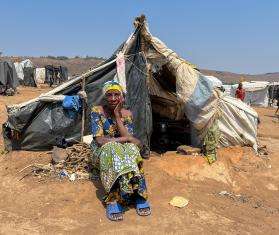
We identified the areas in the country with the highest needs and went in to support. At the same time, we had an emergency intervention that we were not planning on, when 70,000 refugees from Democratic Republic of Congo had to flee to Burundi, which didn't have the infrastructure to handle all of it. We were making sure that they had medical care, [despite] shortages and [our] inability to treat [everyone]. We were also the majority provider of water to everyone in the camps.
There also was a cholera outbreak, and we were dealing with lots of different health issues. This was all happening while we were planning to open another project. On any given day in logistics, that means making sure the projects have what they need, trying to figure out what is needed so that we can properly plan for the future. It means bringing in materials and ensuring transportation is safe in a place where I have never seen a bigger fuel shortage. And this was before the global fuel shortage.
CHIGO: Is there any such thing as a typical day for a logistician? And if there is, what would it entail?
URSHULA: It is really tough to describe a “typical” day. Working in supply chain, theoretically we are the most stable and reliable, because we're the teams that try to forecast. We're the ones that try to plan so that everyone else is able to respond.
When I arrived in Burundi, I had my schedule planned down to the half-day of what I was going to accomplish during each day that I was there. Then we had the fuel crisis, and then we had this project opening up, and you just keep rolling with what comes to make sure that everyone has what they need. You know that each day you're going to work with the team that organizes our transport to figure out how we're going to get things from point A to point B.
We also have our local teams who run things and keep things moving day-to-day: the customs supervisor who does all the paperwork to bring things into the country, the warehouse team who picks and pulls orders, etc. Unfortunately, even for them, they deal with the influx of refugees coming in, and new outbreaks coming in every day, so we all have to pivot.
CHIGO: As a logistician, who are the people you work the closest with day to day?
URSHULA: My team in the supply chain tends to include someone who's organizing all of our imports, doing customs and transport. We also have someone managing warehouses and keeping track of inventory, as well as doing all of the encoding to make sure that we keep track for forecasting purposes.
We have people doing that both for logistics materials and medications. We have purchasers who go through the local community to buy whatever we can find locally, because we prefer to stimulate the local economy when we can. I have a supply officer who just encodes, communicates, follows the history, and there's no shortage to what they do. That's just within the supply team I work with directly. There's never a day where we're not coordinating and working directly with all of our teams. We also deal with other NGOs that might support us or might need our support.
We spent a lot of time with the Ministry of Health while we were there, just to plan our local projects. On a day-to-day basis, I work with my supply chain team and also communicate with the other departments, so really we're working with everyone.
CHIGO: How important is local knowledge to logistics work?
URSHULA: I don't know how we would operate without local knowledge. They maintain the history, and can advise us on what works and what doesn't. I might have had great success with in other six countries, but I might come into Burundi and that doesn't work. The fuel shortage is a special example because they can tell me why we can't just import, or why we can't just bring things in, or why we need this permission to do something.
Even if international staff might stay around for a year or two, we always end up leaving. All this information, as often as we try to include documentation, stays with them. They are just so important for maintaining, for keeping everything running, and for keeping us on track. They are the reason why I work and continue to work for MSF. I know there are communities around and those are really important, but all of the effort and the input that my local teams provide is invaluable, even with my personal life!
I adopted a cat when I was in Burundi, and the team said: “This cat was abandoned by its mom and was living under a container. Now it has the opportunity to move to the United States and live with a mom that really loves it. We are making sure you take this cat home.”
And so not only did they do their normal work, but they also went to the vets to make sure I could get the vaccinations, and my customs supervisor marched me into the Ministry of Agriculture and actually got the Minister of Agriculture to sign the document that I needed to take my cat out of the country! It's not just that they're there to fulfill a very heavy workload, which they do, but they're also just really such a great source of joy in my life, we're really family, and it's always so hard to leave.
CHIGO: What were you doing before joining MSF?
URSHULA: I was working in supply chain in the private sector, for a very large organization managing operations and the supply chain department. It was the same department, but very different styles of work. I made the switch because I had a cross-country business trip years before joining Doctors Without Borders, and I sat next to a logistician on the plane. We spoke for hours just about the work that he did, and my jaw was just on the floor. I said, “I wish I could do that.” And he asked, “Well, what do you do?” And when I said supply chain, he said, “We need people with experience in that, in fact.” And so I heard about it and a few years later I bit the bullet and dove in.
CHIGO: I wish we could have a podcast on everyone's story on how they joined MSF. What would you say are some of the transferable skills from that setting that have been useful at MSF?
URSHULA: In terms of the actual work, we're forecasting, using the data to track what we're using and what is needed, and bringing all of these things in, planning when things move, and following up with people. We might have different software, but it was really easy to transition using my skills because I said, “Oh, I can make this more efficient with skills that I learned in the private sector.” I figured out how to work on replenishment and models, and to leave tools behind that automated a lot of tasks so they didn't have to click or recalculate every time. I found it quite a smooth transition.
CHIGO: What has your experience been in a male-dominated field like logistics?
URSHULA: It is definitely a male-dominated field and I was surprised at how accepted I was. They just see me as part of the family and part of the team. And often, for example, in South Sudan, there’s a project that we had in a place called Old Fangak, that is experiencing a lot of issues lately.
There are people there who have never seen a car before because it's surrounded by water and there are no motor vehicles there. People hollow out logs to get across the lakes to get anywhere. And so in order to bring in any items, we have to fly them to the nearest patch of dirt where we can land. And then there are a dozen women who take all of our items and carry them on their heads and march through the swampy waters all the way to our boats, and transfer them. These women are so strong! I've learned the word strong in many languages because I hear a lot of our workers describing, “shadid,” which is strong in Arabic.
I like to consider myself strong, but I tried to lift some of the things that I saw these women carrying and I couldn't do it. There's so many communities where the women are the ones that are really driving things. In Burundi, it's a beautiful place and all of the gardening lining the streets is maintained by women. I am finding in places where I would expect men to be, a lot more women are stepping in, especially in the MSF community. When I started, I was quite alone as a woman in the logistics field — there weren't that many of us. But now, I'm seeing that change.
CHIGO: What would be your advice to someone interested in going into logistics or supply chain within MSF or the humanitarian aid field?
URSHULA: I think that people can be confident that their skills are transferable, that even in the humanitarian sector they can use their knowledge to benefit local communities, and I think that's important. There are times when I have to work on transportation and there are no cars, and so I have to figure out how to get things by boat, donkey, or helicopter, or whatever the case may be.
There have been many times that I've had to plan and organize in the past. The constraints and situations are different, but the knowledge really remains the same. Our locally hired staff are really appreciative — I learned so much from them, and then I try to impart the information, knowledge, and tools that I have. It's wonderful to be able to share something with people who are able to support you as well.
CHIGO: In all this time you've been with MSF, what stays with you?
URSHULA: I'm a little bit of a broken record because I've been talking all the time about our local teams and the communities that we work in. But really, it's their stories, their kindness, them helping me get my cat home.
In Gaza, the warehouse supervisor came in to work looking really tired one day, and I asked him what happened. He told me his neighbor's house had been destroyed, and he had been up all night with his crying children, who were really nervous that theirs was going to crumble as well. I said, “What are you doing here, you can go home.” And he told me, “It feels good to be here, to know that despite these things happening around me I'm able to do work that can improve my community. It feels better to come to work than stay at home.”
In Uganda, a chef gave up his career in a restaurant because he saw the work that MSF did and wanted to be able to help. He became one of our cooks, because that was how he could contribute to his community there.
If this podcast were hours long I would still run out of time to talk about all of the impressive people and their stories, kindness, the joy they bring, and the laughter. What sticks with me and keeps me going is just seeing how, in a world where I think people in the United States would really struggle to just operate in, these people are just driving so many things forward and still managing to put a smile on their face every day.
CHIGO: Thank you so much for sharing your experience and giving us a glimpse into this critical role of logistics.
URSHULA: Thank you for having me.
CHIGO: Thank you. To our listeners, if you want to learn more about MSF's work, or explore non-medical roles like logistics, visit doctorswithoutborders.org. Thank you for listening, and until next time.