Developing story
How MSF is responding to the war in Gaza
This is not a ceasefire: Israeli forces continue to strike Gaza while blocking the flow of essential medical and humanitarian supplies.


Developing story
This is not a ceasefire: Israeli forces continue to strike Gaza while blocking the flow of essential medical and humanitarian supplies.
October 5, 2026 — Three years after the escalation of war in Gaza and one year into the so-called ceasefire, Israeli authorities and security forces continue to systematically destroy the conditions people need to survive, said Doctors Without Borders/Médecins Sans Frontières (MSF) today.
Israeli forces’ all-out war on Gaza has systematically destroyed the conditions necessary for life in the Strip — attacking hospitals, striking tented camps and fragile shelters, destroying vital civilian infrastructure, and choking off access to food, water, medicines, and other basic needs for survival. No one is spared.
Since October 2023, more than 74,000 Palestinians have been killed and over 174,000 wounded. Nearly 2,300 health and humanitarian workers have been killed, including 15 of our own Doctors Without Borders/Médecins Sans Frontières (MSF) colleagues. It will take decades to rebuild and recover, and for many Palestinians, the physical and emotional wounds will last a lifetime.
hospital beds supported by MSF
gallons of water distributed per day in 2025
mothers assisted by MSF during childbirth
One year after the so-called ceasefire was announced in October 2025, more than 1,300 Palestinians have been killed and over 4,000 injured. Israel maintains its blockade, preventing sufficient aid from entering the Strip, depriving people of the essentials they need to live, and prolonging this genocide.
Now, more than ever, Palestinians need more humanitarian aid, not less. We reiterate our call for unhindered access to independent, impartial humanitarian aid in Palestine.

Your donation helps Doctors Without Borders respond with lifesaving medical care in Gaza, and everywhere we’re needed.
DonateMSF has over 1,480 staff working in Gaza's health facilities, including public hospitals, field hospitals, clinics, and medical points throughout the Strip. Our teams provide surgical care, wound and burn care, malnutrition screening and treatment, maternal and pediatric services, physiotherapy, vaccination, mental health support, and care for non-communicable diseases, among other services. We also provide water and sanitation support and assist medical evacuations to our reconstructive surgery hospital in Amman, Jordan, where we provide evacuees with rehabilitative care.
MSF teams work in health facilities across Gaza, including its largest hospitals and our own clinics and field hospital. With extremely volatile conditions on the ground, including attacks and evacuation orders, we have had to move from facility to facility and continually adapt our activities since October 2023. As of September 2026, MSF is running or supporting health services in 17 locations in Gaza, including Nasser and Al-Helou hospitals, two field hospitals, four health care centers, five clinics, and four medical points.
Despite the so-called ceasefire, our teams continue to treat patients suffering from blast injuries, fragment wounds, and blunt trauma caused by explosions and gunfire. Many are injured near the Yellow Line — an ever-shifting boundary confining 2 million Palestinians to less than a third of the Strip.
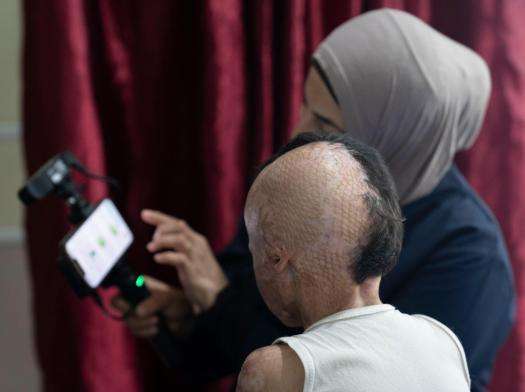
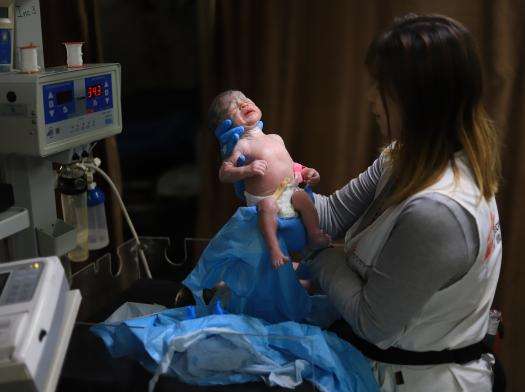
From left: MSF physiotherapist Ibtihal Alwali shows Joud the 3D scanner used to make him a custom pressure therapy mask to heal his facial burns, 2026 © Nour Alsaqqa/MSF; MSF midwife activity manager Hin So checks on a newborn baby at Nasser Hospital, 2024 © Mariam Abu Dagga/MSF.
Due to the decimation of Gaza’s health system by Israeli forces, thousands of Palestinians are unable to access the specialized medical care they need. MSF has assisted in the medical evacuation of 144 patients from Gaza, including 65 who were evacuated to Jordan for rehabilitative care at our reconstructive surgery hospital in Amman.
But this is only a drop in the ocean: More than 18,500 Palestinians require medical evacuation, including 4,000 children, according to the World Health Organization. Many of these patients have severe burns and fractures, amputations, congenital anomalies, and other serious conditions. A clear, predictable medical evacuation system must be established urgently — with full respect to patients’ right to a safe, voluntary, and dignified return to Gaza.
Gaza has no independent means of producing drinkable water, as its groundwater is too salty or contaminated by sewage and agricultural chemicals to be fit for human consumption. Israeli forces have decimated the water network. And with the establishment of the Yellow Line, key water infrastructure is often located within or close to the militarized zone, making it too dangerous to access. Israeli authorities have also blocked the entry of vital water production supplies, leaving authorization requests for items like pumps, spare parts, and tanks pending for months.
MSF is one of the main producers of drinking water in Gaza, producing or distributing over 1 million gallons each day in August alone. Our teams carry out water trucking activities, establish distribution points, and provide technical support to desalination plants, while also supporting longer-term solutions, such as repairing wells, increasing water storage capacity, and developing water networks so people can more reliably access water close to where they live. Since January 2026, we have produced more than 137 gallons of water and have distributed nearly 130 million gallons across Gaza.
The critical water, sanitation, and hygiene conditions in Gaza are increasingly visible in our patients, with MSF teams treating cases of watery diarrhea and preventable skin diseases like chickenpox, impetigo, and scabies.
Earlier this year, Israel barred MSF and other major nongovernmental organizations from working in Gaza and the West Bank, leaving hundreds of thousands of Palestinians unable to access lifesaving health care, water, and other essential services.
Since our international staff were forced to leave Gaza at the end of February, MSF has been operating with about 1,500 Palestinian staff in Gaza and the West Bank (registered under the Palestinian Authority), with international staff providing remote support from Amman. Israeli authorities have also blocked MSF from bringing supplies into Palestine since January. Stocks of medication, medical equipment, and engine oil — essential for generators keeping babies in incubators alive — are critically depleted. This engineered scarcity has made it impossible to meet basic needs.
MSF will continue to provide medical humanitarian care and bear witness to the suffering of the Palestinian people for as long as possible. We are working urgently to preserve access to health care for our patients in an increasingly constrained environment.
The medical needs in Gaza are immense and urgent, not only for people wounded or burned in strikes but for children with malnutrition, pregnant women who are about to deliver, the elderly, and people with chronic diseases. At the same time, the provision of care has become even more challenging due to the systematic dismantling of Gaza’s health system, with repeated attacks by Israeli forces on health facilities and personnel, as well as shortages of essential supplies including vital medicines and medical equipment. The core medical needs our teams are seeing on the ground include:
Many patients in Gaza require care for war wounds, crush injuries, and burns sustained in bombings and other attacks by Israeli forces. In 2025, MSF teams saw an increase in the number of patients with burn injuries — most of them children. Many of these children were burned by bomb blasts; others by boiling water or fuel used for cooking or heating in makeshift shelters. And for those wounded, infections are a growing concern due to difficulty accessing care and follow-up, shortages of supplies, and lack of access to hygiene.
Our teams have been operating with a severe shortage of medical supplies like anesthetics, pediatric antibiotics, and medicines for chronic conditions like epilepsy, hypertension, and diabetes as a result of the blockade. Staff have been forced to ration medications and even turn some patients away because they don’t have the proper tools to treat them.
As of September 2026, Israeli authorities continue to restrict the entry of critical supplies, including wheelchairs, oxygen cylinders, crutches, and other essential items people need to recover. And restrictions on fuel, engine oil, and spare parts are pushing generators to the breaking point; if they break down, entire hospital departments won’t be able to function.
On August 22, 2025, the United Nations-coordinated Integrated Food Security Phase Classification (IPC) system officially declared famine in Gaza governorate, in the north of the Gaza Strip, indicating a severe risk of malnutrition, with children being the most vulnerable. Israel’s manufactured malnutrition crisis in Gaza had a devastating impact on pregnant and breastfeeding women, newborns, and infants under 6 months old during periods of intense hostilities and siege: Between late 2024 and early 2026, our teams at four health facilities recorded higher levels of miscarriage as well as prematurity and mortality among infants born to mothers affected by malnutrition during their pregnancy.
Even before the current war started, many years of instability had already taken a toll on the physical and mental health of Gaza’s children, leaving many with life-changing injuries, amputated limbs, and the trauma of losing parents and other loved ones along with their homes and schools. Children are also especially vulnerable to various health risks arising from insufficient access to water, food, and warm shelter.
Pregnant women in Gaza have been forced to navigate severe obstacles to reach medical facilities for prenatal care or delivery, including traveling dangerous routes amid fighting and without safe transportation, which can delay access to care and increase the risk of complications. Those able to reach a hospital often find them without capacity, and end up giving birth in plastic tents or public spaces; others must return to their makeshift shelters mere hours after undergoing cesarean sections. To date, MSF teams have assisted more than 27,000 deliveries in Gaza.
Since October 2023, Palestinians in the West Bank have faced an escalation of violence by Israeli forces and settlers, including movement restrictions, obstructions of health care, demolition of homes, and forced displacement. This year marks a sharp escalation in settler violence; in the first half of 2026, incidents were up by 45 percent compared to the same period in 2025. According to OCHA, more than 1,100 Palestinians have been killed by Israeli forces or settlers in the West Bank over the past three years, including at least 239 children, and a total of at least 91 deaths this year alone.
MSF calls for an immediate end to forced displacement and military aggression against Palestinians in the West Bank. This includes prolonged military operations, movement restrictions, demolitions, disproportionate use of force, cooperation with and facilitation of settler violence, and denial of essential services — including obstructions to healthcare.
Our teams in the West Bank are working to reach communities where people are unable to access care, such as the north of the occupied territory and remote areas like Masafer Yatta in the south. We aim to bolster the local emergency response capacity, including by training health care workers and teaching community members how to provide first aid if they are unable to reach care when it’s needed. We also distribute relief items for displaced people.
In Nablus and Hebron, MSF teams provide psychosocial support; care for sexual and gender-based violence; and psychological, emergency, and first response training. In Hebron, we run mobile clinics providing general health care, sexual and reproductive health care, and mental health support, and run rapid responses for home demolitions, attacks on the water and sanitation systems, and other incidents.
Between January and July 2026, MSF teams in the West Bank provided more than 3,000 individual mental health consultations and 436 group therapy sessions.
MSF does not currently run medical programs in Israel but offered its support to Israeli hospitals treating large numbers of casualties following the Hamas attacks on October 7, 2023. We focus on filling the greatest gaps in health care, and Israel has strong emergency and health systems.
MSF provides medical care to anyone who needs it, regardless of race, religion, or political affiliation. As an organization, we focus on filling the greatest gaps in health care.
To facilitate our humanitarian and medical work, we speak to all parties to the conflict to request safe, rapid, and unimpeded access to civilians who require medical care and to ensure the safety and security of our staff. Our independence and impartiality are essential to our work in all the places we operate across the globe. We also believe that the principles of impartiality and neutrality are not synonymous with silence. When the world turns its back on crises, we are duty-bound to raise our voices and speak out on behalf of our patients. Our decision to do so is always guided by our mission to do no harm, preserve respect and dignity, and protect life and health.
These masks apply consistent pressure to heal facial burns, but since Israeli authorities revoked MSF’s registration to work in Palestine — along with 37 other NGOs — on December 3, 2025, we've been unable to get new supplies into Gaza.
MSF response in Gaza
October 2025 – September 2026
986,862 outpatient consultations
67,911 trauma cases treated
342,006 emergency presentations
29,162 people treated for diarrhea
21,634 surgical procedures
40,157 inpatients admitted
10,307 deliveries
66,059 individual mental health sessions
32,251 routine vaccinations

1,300+ Palestinians killed in Gaza since the October 2025 ceasefire
58,000+ children have lost one or both parents
76.6 percent of structures destroyed or damaged
2,200+ health and humanitarian workers killed, including 15 MSF staff

"Our teams are working hard to continue providing care, but they are under immense strain. Dedication and last-resort solutions cannot replace a stable and unhindered entry of supplies. We need medical supplies and equipment to enter Gaza now."
Dr. Randa Abu El-khair Masoud
MSF project medical referent in Gaza
"Even during what’s been called a ceasefire, it has never truly felt like the fire has stopped. Drones were constantly overhead. You could hear airstrikes every day. The number of mass casualties may have decreased compared to before the agreement, but violence never disappeared."
— Rocío Simón Martínez
MSF nurse activity manager


Health care staff and humanitarian workers must be protected.
Read more
Key moments over three years of siege, bombardment, and attacks on health care.
Some humanitarian crises make the headlines—others don’t. Unrestricted support from our donors allows us to mobilize quickly and efficiently to provide lifesaving medical care to the people who need it most, whether those needs are in the spotlight or not. And your donation is 100 percent tax-deductible.